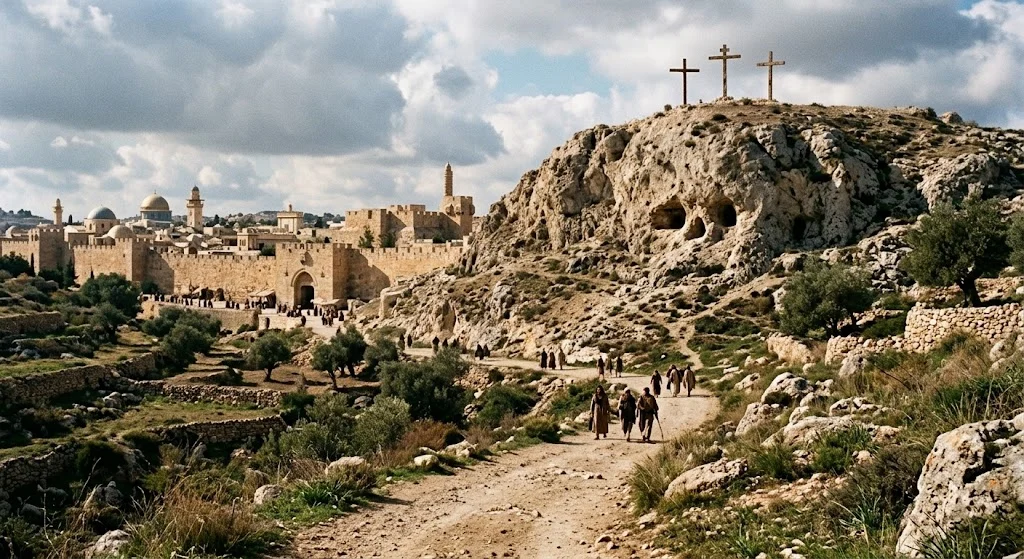
Golgotha means “Place of the Skull.” It is the hill outside ancient Jerusalem where, according to the Bible, Jesus Christ was crucified. The name comes from the Aramaic word Gulgalta, meaning “skull,” and in Latin it is called Calvary.
The word Golgotha carries deep historical and religious significance because it identifies the place where Jesus Christ was crucified, according to the New Testament. Often translated as “Place of a Skull,” the name appears in the Gospel accounts of Jesus’ final hours and has become closely associated with sacrifice, suffering, forgiveness, and redemption in Christianity.
Golgotha is more than a name mentioned in the Bible. It connects readers to the geography of ancient Jerusalem, the Roman practice of crucifixion, and the central beliefs of Christian faith. Understanding its original language, possible physical location, and symbolic meaning helps explain why this place remains important to Christians around the world.
Table of Contents
- What Does Golgotha Mean in the Bible?
- The Origin and Language of the Name
- Where Was Golgotha Located?
- Why Was It Called the Place of a Skull?
- Golgotha in the Four Gospels
- The Religious Significance of Golgotha
- Golgotha vs. Calvary vs. Jerusalem
- Common Misunderstandings About Golgotha
- Frequently Asked Questions
- Final Thoughts
What Does Golgotha Mean in the Bible?
Golgotha is the name of the place outside Jerusalem where Jesus Christ was crucified, according to the New Testament. The Gospel writers identify it as the location where Roman authorities executed Jesus, an event that stands at the center of Christian teaching.
The name is commonly translated as “Place of a Skull.” This translation is explicit in the Gospel accounts, including Matthew 27:33 and Mark 15:22.
The word itself does not mean resurrection, forgiveness, or salvation. Those ideas are associated with the events Christians believe took place at this location and with the theological meaning they assign to Jesus’ death and resurrection.
In the biblical narrative, Golgotha is the setting for several important events:
- Jesus is crucified between two other condemned men in the Gospel accounts.
- Roman soldiers divide his garments, a detail recorded in the crucifixion narratives.
- Jesus speaks his final words, with the specific wording varying between the Gospels.
- Jesus dies on the cross, followed by his burial and, according to Christian belief, his resurrection.
These events explain why the name appears frequently in Christian sermons, Holy Week readings, hymns, and religious artwork.
The Origin and Language of the Name
The name has a history that connects Aramaic, Greek, Latin, and English. Each language preserves a version of the same basic meaning.
Aramaic roots
Aramaic was widely spoken in the region during the first century, and it was one of the languages associated with everyday life in Roman-era Judea. The New Testament preserves several Aramaic expressions, including the name Golgotha.
The word is commonly explained as deriving from an Aramaic term related to a skull or the head. Its biblical translation, “Place of a Skull,” reflects that connection.
Greek translation
The New Testament was written primarily in Greek, and the Gospel accounts preserve the name in Greek form. In John 19:17, the location is called Kranion, a Greek word meaning “skull.”
The Greek wording helps explain the meaning for readers who may not know Aramaic.
Latin and the English word Calvary
The Latin expression Calvariae Locus means “place of the skull.” The Latin word calvaria refers to a skull and is the source of the English religious term Calvary.
The linguistic relationship can be summarized as follows.
| Language | Term | Meaning or significance |
|---|---|---|
| Aramaic | Golgotha | The traditional name of the crucifixion site |
| Greek | Kranion | Skull |
| Latin | Calvariae Locus | Place of a skull |
| English | Calvary | Traditional Christian name for the crucifixion site |
These terms are related, but their historical forms differ. Golgotha is the familiar Aramaic-derived name, while Calvary comes through Latin.
Where Was Golgotha Located?
Golgotha was located near Jerusalem, in the area where Jesus was executed under Roman authority, according to the New Testament. The exact spot remains a subject of historical discussion because the biblical accounts do not provide modern geographical coordinates or a detailed description of the surrounding terrain.
Two locations are particularly important in discussions about the site.
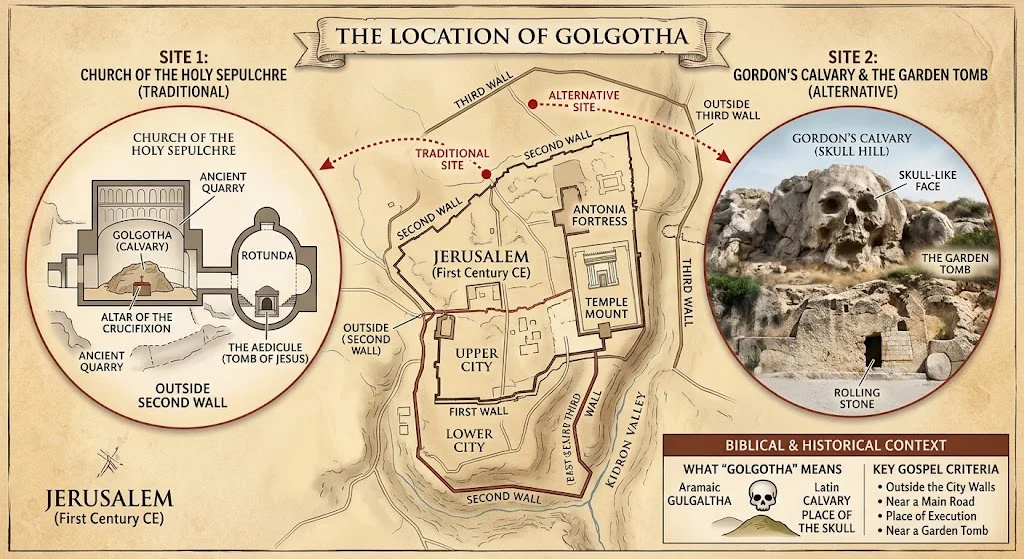
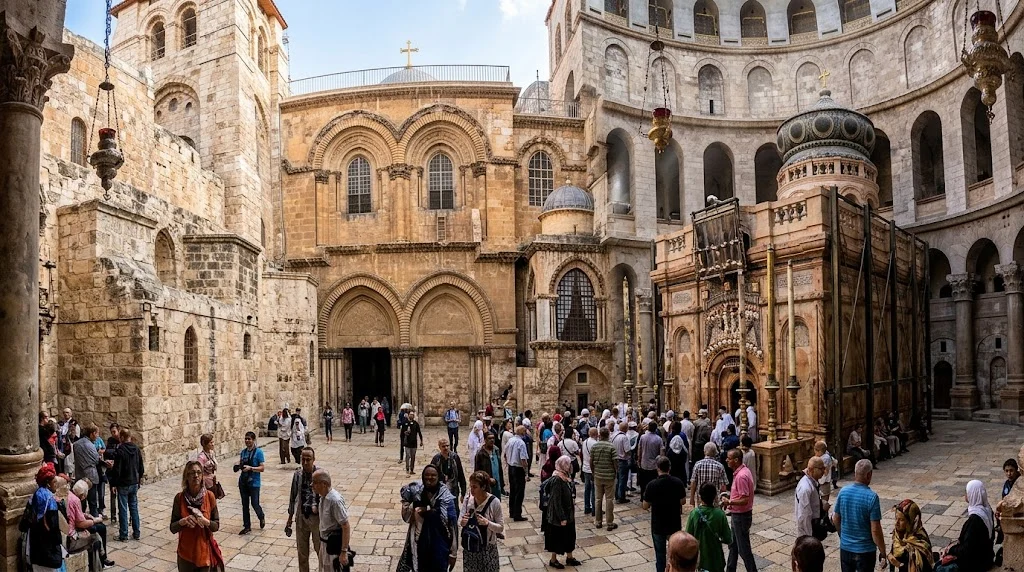
1. Church of the Holy Sepulchre
This church in Jerusalem’s Old City is the traditional Christian site associated with Jesus’ crucifixion, burial, and resurrection. Its long history of Christian worship makes it one of the most significant pilgrimage destinations in Christianity.
2. Garden Tomb area
Located outside the Old City walls near a rocky formation sometimes called Skull Hill, this site is regarded by some Protestant Christians as a possible location for Jesus’ crucifixion and burial.
The Church of the Holy Sepulchre
The Church of the Holy Sepulchre has been associated with the crucifixion and burial sites since the early centuries of Christianity. The Roman emperor Constantine supported the construction of a church there in the fourth century, following the identification of the location as a sacred Christian site.
The church stands within today’s Old City, but parts of the area lay outside Jerusalem’s walls during the first century. That distinction matters because Roman crucifixions commonly took place outside city boundaries.
The traditional identification has a long history, although historical tradition alone cannot settle every question about the precise execution site.
The Garden Tomb and Skull Hill
The Garden Tomb is another place visited by Christians who wish to reflect on Jesus’ death and resurrection. Its garden setting and nearby rock formation make it visually compelling for some visitors.
However, a resemblance between a rock formation and a skull does not prove that it was the biblical Golgotha. The relationship between the site’s archaeological evidence and the Gospel accounts remains debated.
A scholarly discussion published in New Testament Studies by Cambridge University Press examines historical and archaeological evidence concerning the possible locations of the crucifixion and burial. It illustrates why researchers distinguish between the biblical description, later Christian tradition, and evidence that can be established historically.
The key distinction: Christians may recognize a traditional pilgrimage site as sacred without claiming that every detail of its precise location has been proven beyond dispute.
Why Was It Called the Place of a Skull?
The Bible provides the name’s basic explanation but does not give a definitive account of why the location received it. Several interpretations have developed over time.
A skull-shaped rock or hill
One common explanation is that the location’s physical appearance resembled a human skull. This interpretation is frequently connected with the rocky formation near the Garden Tomb.
The idea is easy to understand, but it should be treated as a possible explanation rather than an established historical fact. There is no conclusive evidence that a particular skull-shaped formation gave the original site its name.
A place associated with execution
Another possibility connects the name with the area’s association with death and execution. Crucifixion was a public Roman punishment, and an execution site could have become associated with death in local memory.
Still, the Gospel writers do not explicitly say that Golgotha was named after executions or that human skulls were scattered there. Such explanations go beyond what the biblical text directly states.
A symbolic association with death
The word “skull” naturally evokes mortality. Because Jesus’ crucifixion took place at Golgotha in the Gospel narratives, the name has acquired a powerful association with suffering, death, and the Christian understanding of redemption.
This symbolic association is clear in later Christian tradition, even though it does not establish the original reason for the place name.
It helps to separate two questions: what the name literally means and why people originally used it. The first has a clear answer in the Gospels. The second remains uncertain.
Golgotha in the Four Gospels
All four canonical Gospels describe Jesus’ crucifixion, but they differ in their wording, details, and narrative emphasis. Comparing them gives readers a fuller understanding of how the event is presented in the New Testament.
| Gospel | Biblical reference | Relevant detail |
|---|---|---|
| Matthew | Matthew 27:33–54 | Names Golgotha as the Place of a Skull and describes events surrounding Jesus’ death |
| Mark | Mark 15:22–39 | Identifies the location and recounts the crucifixion and the Roman centurion’s response |
| Luke | Luke 23:33–49 | Describes the crucifixion at a place called the Skull and includes Jesus’ words to the condemned men |
| John | John 19:17–30 | Gives the Aramaic name Golgotha and describes the inscription placed on Jesus’ cross |
Matthew 27:33 and Mark 15:22 explicitly explain the name’s meaning. John 19:17 also identifies the location as the Place of the Skull and preserves the name Golgotha.
Luke uses the expression “the Skull” in Luke 23:33, showing that the place was known by the same basic designation.
These accounts should not be treated as four identical reports. Each Gospel has its own literary emphasis, and some details appear in one account but not another. Reading them together helps explain the significance of the crucifixion while preserving the differences in their presentations.
What happened at Golgotha?
According to the Gospel narratives, Jesus was brought to the site and crucified alongside two other condemned men. Roman soldiers carried out the execution, and an inscription identifying Jesus as “the King of the Jews” appeared on the cross in the accounts that describe it.
The narratives also describe people watching, soldiers dividing Jesus’ clothing, and reactions to his death. The exact sequence and details vary among the Gospel writers.
For Christians, these events form part of the Passion of Christ, the term used for Jesus’ suffering and death. The word Passion comes from a Latin term associated with suffering, not simply strong emotion.
The Religious Significance of Golgotha
Golgotha has a central place in Christian theology because it is associated with the death of Jesus Christ. Its importance goes beyond the physical location. For Christians, it represents the meeting point of suffering, sacrifice, forgiveness, and hope.
1. Sacrifice and redemption
Many Christian traditions understand Jesus’ death as a sacrifice made for humanity’s sins. This belief is connected with the New Testament teaching that Jesus’ death brings reconciliation between humanity and God.
The theological explanations differ among Christian denominations, but the crucifixion remains central to Christian faith. Golgotha serves as the geographical setting for this event in the biblical narrative.
2. Forgiveness and mercy
The crucifixion accounts have shaped Christian teachings about mercy and forgiveness. Luke 23:34, for example, records Jesus praying for forgiveness for those responsible for his execution in many Bible translations.
This passage is especially important to Christians who see the crucifixion as an example of compassion in the face of cruelty. Interpretations of the passage and its textual history vary, but its traditional use in Christian reflection is well established.
3. Suffering and human vulnerability
Golgotha also reminds believers that the Christian story includes physical suffering, injustice, and death. Jesus’ crucifixion is not presented as an easy or painless event.
For people experiencing grief or hardship, the story can offer a way to reflect on suffering without pretending that pain is insignificant. Christian communities often connect this theme with prayer, pastoral care, and support for people in difficult circumstances.
4. Hope through the resurrection
Although Golgotha is associated with Jesus’ death, Christian belief does not end at the cross. The resurrection narratives that follow the crucifixion are essential to the meaning Christians assign to the event.
For this reason, the cross is understood not only as a symbol of death but also as a sign of hope. Easter celebrations connect the crucifixion with the belief that death does not have the final word.
Why Golgotha matters to Christians today
The site remains significant through worship, pilgrimage, art, music, and religious observances. During Holy Week, many churches read the Passion narratives and reflect on the final events of Jesus’ life.
Good Friday, observed by many Christian denominations, commemorates Jesus’ crucifixion. Some communities hold processions, prayer services, or Stations of the Cross, a devotional practice that follows key moments associated with Jesus’ journey to his execution.
The importance of Golgotha therefore continues in both religious practice and personal reflection. Its significance comes from the events Christians associate with the place and the beliefs those events express.
Golgotha vs. Calvary vs. Jerusalem
These three terms are related, but they do not mean exactly the same thing. Understanding the difference prevents confusion when reading the Bible or studying Christian history.
| Term | What it refers to | Main distinction |
|---|---|---|
| Golgotha | The named place of Jesus’ crucifixion | The Aramaic-derived name traditionally translated as Place of a Skull |
| Calvary | Another name for the crucifixion site | An English term derived through Latin |
| Jerusalem | The ancient city where the events of Jesus’ final days took place | The broader geographical setting, not the name of the execution site |
Golgotha and Calvary refer to the same biblical location, rather than two separate places. Jerusalem, by contrast, is the city associated with the wider events of Jesus’ final days, including his arrest, trial, crucifixion, and burial.
The distinction is useful when reading different Bible translations. For example, some older English translations use Calvary in Luke 23:33, while many modern translations use “the Skull” or a similar expression.
The difference in wording reflects the history of translation rather than a different account of where Jesus was crucified.
Common Misunderstandings About Golgotha
Several misconceptions can arise when the name is discussed outside its biblical context.
Misunderstanding 1: Golgotha means resurrection.
The literal meaning is “Place of a Skull.” Resurrection is connected with the Christian story associated with Jesus’ death, but it is not the word’s direct translation.
Misunderstanding 2: Golgotha and Calvary are separate places.
They are two names for the same crucifixion site in Christian tradition. Their difference comes from their linguistic histories.
Misunderstanding 3: The exact location has been conclusively proven.
The Church of the Holy Sepulchre is the traditional site, while other locations have also been proposed. Historical research examines the evidence, but the exact location cannot be established with complete certainty.
Misunderstanding 4: The Bible explains exactly why the place was named after a skull.
The Gospels explain what the name means, but they do not conclusively explain how the place acquired that name.
Distinguishing biblical statements from later explanations makes it easier to understand the subject accurately.
Frequently Asked Questions
1. Is Golgotha a Hebrew or Aramaic word?
Golgotha is generally identified as an Aramaic name. John 19:17 preserves the name in the account of Jesus carrying his cross. Some English Bible translations use “Hebrew” as a broader label for the language associated with the Jewish people, but Aramaic is the more precise linguistic identification in this context.
2. Is Golgotha mentioned in the Old Testament?
No. The name Golgotha appears in the New Testament accounts of Jesus’ crucifixion, not in the Old Testament. Its significance comes from the Gospel narratives and later Christian tradition.
3. What is the pronunciation of Golgotha?
In English, Golgotha is commonly pronounced GOL-guh-thuh, with the stress on the first syllable. Pronunciation can vary slightly by accent and language.
4. Why do churches display crosses associated with Golgotha?
The cross recalls Jesus’ crucifixion, which Christians understand as central to their faith. It can symbolize sacrifice, forgiveness, redemption, and hope. Different churches use the cross in different ways, including in worship spaces, personal jewelry, artwork, and religious ceremonies.
5. Can visitors go to Golgotha today?
Visitors can explore the traditional crucifixion site at the Church of the Holy Sepulchre in Jerusalem. The Garden Tomb is another Christian site associated by some visitors with the crucifixion and burial. Travelers should check current access arrangements and local conditions before visiting.
Final Thoughts
Golgotha is a name rooted in the biblical account of Jesus’ crucifixion, with a literal meaning that connects it to a skull. Its historical location has been discussed for centuries, while its religious significance remains central to Christian worship and reflection.
Learning about its language, biblical references, and symbolism provides a clearer understanding of why this ancient place continues to matter to millions of people.