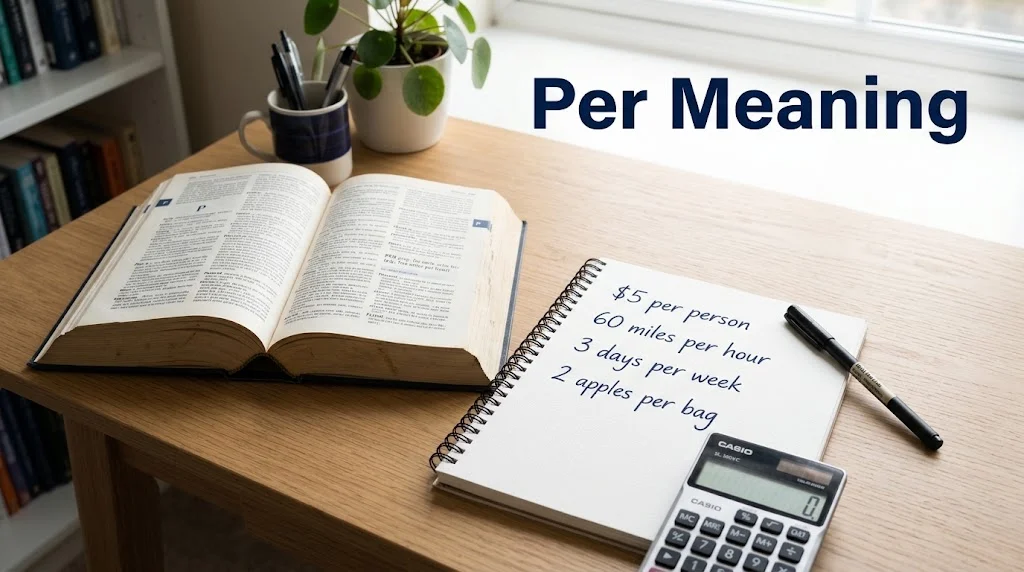
The word per means “for each,” “for every,” or “according to,” depending on the context. It is commonly used to describe rates, prices, measurements, and time, as in “$5 per person,” “60 miles per hour,” and “three times per week.” It can also mean “by means of” or “in accordance with” in certain formal expressions, such as “as per the instructions.” Understanding the surrounding words makes its intended meaning easy to identify.
The word “per” appears in everyday conversations, business documents, financial reports, and measurements, but its meaning can change depending on the context. It most commonly means “for each” or “for every,” as in “$5 per person” or “60 miles per hour.” You may also encounter it in formal expressions such as “per your request,” where it means “according to.”
Understanding how this short word works can help you interpret prices, compare measurements, and write clearer sentences. In this guide, you will learn its definition, common uses, practical examples, and differences from similar English words so you can use it confidently in everyday communication.
Table of Contents
- What Does Per Mean?
- How Is Per Used in Everyday English?
- Common Uses of Per With Examples
- Per in Mathematics, Science, and Measurements
- Per vs. Other Similar Words
- Common Expressions That Use Per
- Common Mistakes to Avoid
- Frequently Asked Questions
What Does Per Mean?
Per is a preposition used to express a relationship between two things, particularly when describing an amount for each person, item, or unit of time. It helps explain how much something costs, how frequently something happens, or how one measurement relates to another.
For example, if a parking garage charges $4 per hour, you pay four dollars for every hour you park. If a recipe calls for two eggs per person, each person should receive two eggs.
The word is short, but its meaning changes slightly with context. In everyday conversation, it usually means “for each” or “for every.” In formal writing, it can mean “in accordance with,” as in “as per your request.”
The word comes through Latin per, meaning “through,” “by,” or “for.” Its modern English uses reflect this range of relationships.
Basic Definition at a Glance
| Expression | Meaning | Example |
|---|---|---|
| Per person | For each person | Tickets cost $12 per person. |
| Per day | For every day | The hotel charges $90 per day. |
| Per hour | For each hour | The worker earns $20 per hour. |
| Per mile | For every mile | The vehicle costs 15 cents per mile to operate. |
| As per | In accordance with | As per the agreement, payment is due Friday. |
The key idea is that per connects an amount, action, or condition to a particular unit or rule.
How Is Per Used in Everyday English?
You will often see this word in shopping, workplace communication, travel information, school assignments, and everyday conversations. The meaning is usually straightforward once you identify the unit or instruction that follows it.
1. Per Means “For Each”
This is the most common use. It tells you the amount assigned to each individual item, person, or unit.
Examples:
- The notebooks cost $3 per book.
- Each student may bring one guest per ticket.
- The bakery sells muffins for $2 per piece.
- The gym charges $25 per member each month.
In the first example, every notebook costs three dollars. In the last example, the membership charge applies to each member for the stated period.
2. Per Describes Frequency
When used with a period of time, the word explains how often something happens or how much applies during that period.
Examples:
- She visits the dentist twice per year.
- The company pays its employees per month.
- I exercise four times per week.
- The machine produces 100 items per minute.
Notice that the unit changes the meaning. “Four times per week” describes frequency, while “100 items per minute” describes a production rate.
3. Per Means “According to” in Formal Expressions
In business emails, instructions, and official documents, per can mean “according to” or “in accordance with.”
Examples:
- Per your request, I have attached the report.
- Per the manager’s instructions, the office will close early.
- The payment was processed per the agreement.
This usage is generally more formal than ordinary conversation. In many situations, “according to your request” or “following the manager’s instructions” sounds more natural.
The expression does not automatically prove that a rule was followed correctly. It simply refers to the request, instruction, or agreement being mentioned.
4. Per Can Mean “By Means of”
In some contexts, it refers to a method or means of doing something. This use is less common in everyday English than the rate-related meaning.
For example:
- The documents were sent per courier.
- The confirmation arrived per email.
Although these expressions can be understood, most modern writers would prefer “by courier” and “by email.” Choosing the more familiar expression often makes a sentence clearer.
Common Uses of Per With Examples
The following table shows how the meaning changes according to the words around it.
| Expression | What it communicates | Example |
|---|---|---|
| Per person | Cost or amount for each individual | Lunch costs $18 per person. |
| Per hour | Amount for each hour | The tutor charges $30 per hour. |
| Per day | Amount or frequency for each day | The service costs $8 per day. |
| Per week | Amount or frequency for each week | We meet twice per week. |
| Per month | Amount for each month | Rent is $1,200 per month. |
| Per year | Amount or frequency for each year | The subscription costs $60 per year. |
| Per mile | Amount for each mile | The delivery fee is 50 cents per mile. |
| Per serving | Amount for one serving | The soup contains 150 calories per serving. |
| Per capita | Amount for each person in a population | The report compares income per capita. |
| As per | In accordance with something | As per the notice, the library opens at nine. |
These expressions appear in different settings, but they share one feature: the word links an amount, frequency, or action to a specific unit or reference.
Per in Mathematics, Science, and Measurements
In mathematics and scientific writing, per often expresses a rate or ratio. A ratio compares one quantity with another, while a rate compares quantities measured in different units, such as distance and time.
This usage is especially important because it helps people understand measurements that would otherwise be difficult to compare.
Per in Speed Measurements
Consider the expression 60 miles per hour. It means that an object travels 60 miles for every hour at that rate.
The abbreviation mph stands for miles per hour. Similarly, kilometers per hour is written as km/h.
Examples include:
- A car travels at 60 miles per hour.
- A cyclist averages 20 kilometers per hour.
- A runner covers a short distance at 10 kilometers per hour.
These figures describe rates. They do not necessarily mean that the vehicle or person maintains the same speed throughout an entire journey.
Per in Prices and Unit Costs
Stores often use unit prices to help shoppers compare products of different sizes.
Imagine two packages of rice:
- Package A costs $6 for 3 pounds.
- Package B costs $10 for 5 pounds.
Package A costs $2 per pound. Package B also costs $2 per pound. Although the packages have different total prices, their unit costs are identical.
The calculation is simple:
\[ \text{Price per unit}=\frac{\text{Total price}}{\text{Number of units}} \]
For Package A, divide $6 by 3 pounds. The result is $2 per pound.
This approach is useful for comparing groceries, fuel, household supplies, and other products. However, the lowest unit price is not always the best purchase if you cannot use the entire quantity before it expires.
Per in Science and Health Information
Scientific reports frequently use this word to express measurements relative to a defined unit.
For example:
- Grams per liter can describe the concentration of a substance.
- Beats per minute describes heart rate.
- Calories per serving describes the energy in a stated portion of food.
- Cases per 100,000 people can help researchers compare disease rates across populations.
The unit matters. A value of 20 grams per liter is different from 20 grams per milliliter because a liter and a milliliter represent very different volumes.
Likewise, comparisons between populations may require a common denominator. A place with more reported cases may simply have more residents, so a rate per 100,000 people can provide a more useful comparison than the raw number alone.
The denominator, or the quantity after per, tells readers what the measurement is being compared against.
Per in Business and Finance
In financial writing, the term appears in expressions such as earnings per share, cost per acquisition, and revenue per customer.
Each expression measures something different:
- Earnings per share: A company’s earnings divided by the relevant number of shares, using the calculation specified in its financial reporting.
- Cost per acquisition: The cost associated with acquiring a customer or completing a defined acquisition.
- Revenue per customer: Revenue divided by the number of customers included in the calculation.
These measures can help people compare performance, but their definitions and calculation periods must be consistent. Two figures labeled with the same expression may not be directly comparable if the organizations calculate them differently.
Per vs. Other Similar Words
Several English words can replace per in certain sentences, but they do not always communicate exactly the same thing.
| Word or phrase | Main meaning | Example | Difference from per |
|---|---|---|---|
| Each | Every individual in a group | Each ticket costs $10. | Places emphasis on individual items. |
| Every | All members of a group or repeated intervals | The bus arrives every hour. | Often describes regular intervals or a whole group. |
| For each | An amount or action assigned to each item | You receive one coupon for each purchase. | A direct alternative in many sentences. |
| According to | In agreement with a source or instruction | According to the email, the meeting is canceled. | Identifies the source of information. |
| By | A method, agent, or means | The package was sent by mail. | Often sounds more natural when describing a method. |
| For every | An amount or relationship repeated across units | There is one teacher for every 20 students. | Makes the relationship explicit. |
Is Per the Same as Each?
Not always, although the words overlap in meaning.
Consider these sentences:
- The apples cost $2 per kilogram.
- The apples cost $2 each.
The first sentence gives the price for a unit of weight. The second gives the price of one individual apple. Both communicate a unit price, but the unit differs.
You can also place each before a noun, as in “each student received a certificate.” In contrast, per usually appears before a unit without an article, as in “per student.”
Is Per the Same as According To?
The two expressions can be interchangeable when referring to instructions or requests, but not when describing rates.
For example, “per the instructions” can mean “according to the instructions.” However, “60 miles per hour” cannot be replaced with “60 miles according to hour.”
The surrounding words determine which substitution, if any, makes sense.
Common Expressions That Use Per
Certain phrases occur so often that learning them individually can make English easier to understand.
Per Capita
Per capita means “per person” or “for each person.” It is commonly used in economics, statistics, and population studies.
For example, a report might compare annual income per capita between two countries. The figure represents income relative to population, according to the report’s particular calculation.
It does not mean every resident earns that amount. An average can hide substantial differences between individuals and households.
Per Se
Per se is a Latin expression used in English to mean “in itself” or “by itself.” It is different from the ordinary preposition per.
Example: “The policy is not unfair per se, but its application may create problems.”
Here, the speaker means that the policy is not inherently unfair. The expression does not describe a rate or an amount for each unit.
Per Diem
Per diem is a Latin expression meaning “per day.” In employment and business, it can refer to a daily allowance for expenses incurred during work-related travel.
For example, an employee might receive a specified daily allowance for meals during a business trip. The actual rules depend on the employer’s policy and any applicable regulations.
A daily allowance should not automatically be confused with an employee’s daily wage. The purpose and terms of the payment matter.
Per Annum
Per annum means “per year” or “annually.” It often appears in financial, legal, and business documents.
Example: “The account pays interest at a stated rate of 4% per annum.”
This expression identifies the annual period associated with the rate. The amount actually earned may depend on the balance, compounding method, fees, and other account conditions.
As Per Usual
As per usual is an informal expression meaning “as usual” or “in the usual way.”
Example: “He arrived late, as per usual.”
It can sound conversational or mildly sarcastic, depending on the speaker’s tone. In most ordinary sentences, “as usual” is shorter and more natural.
Per Your Request
This expression is common in professional emails. It means that something is being provided or done in response to a request.
Example: “Per your request, I have included the updated document.”
A friendlier alternative is “As requested, I’ve included the updated document.” Both are understandable, but the second may sound less stiff.
Common Mistakes to Avoid
Even though the word is simple, several small errors can make a sentence sound unnatural or change its meaning.
1. Adding an Article Before the Unit
A common grammatical mistake is writing “per an hour” when the intended expression is “per hour.”
Correct examples:
- 50 miles per hour
- $15 per person
- Three visits per month
- 100 words per minute
In standard rate expressions, per normally goes directly before the singular unit without a or an. This is the pattern used in standard dictionary examples from Cambridge and Oxford.
2. Confusing a Rate With a Total
If a hotel charges $100 per night, that does not necessarily mean the entire stay costs $100.
For a three-night stay, the basic room charge would be $300 before any additional taxes, fees, or discounts. Always check whether the stated figure applies to one unit or the complete purchase.
3. Using Per When Another Word Is Clearer
Although “per your request” is grammatically understandable, “as requested” often sounds more natural.
Similarly, “by email” is generally more familiar than “per email.” Choose language that fits the situation rather than using formal expressions simply because they sound professional.
4. Confusing Per With Percent
These words are related historically but serve different purposes in modern English.
- Per: Expresses a relationship between quantities or refers to instructions in certain phrases.
- Percent: Means a number out of 100.
For example, “$5 per item” gives a unit price, while “5 percent off” describes a discount equal to five out of every hundred of the relevant price.
5. Ignoring the Unit in a Measurement
A number without its unit may be incomplete or misleading. Saying that a machine processes 100 items does not tell you how quickly it works. Saying it processes 100 items per minute supplies the missing time unit.
When reading reports, advertisements, or scientific information, pay attention to the full measurement rather than the number alone.
Frequently Asked Questions
What does per mean in simple words?
Per usually means “for each” or “for every.” For example, $5 per item means each item costs five dollars. In formal expressions, it can also mean “according to.”
What does per mean in a text message?
In a text message, per generally has the same meaning as in standard English. Someone might write “per our conversation” to refer to something discussed earlier or “$10 per person” to explain a cost. Its intended meaning depends on the surrounding message.
What does $20 per person mean?
It means each person is charged $20. For a group of four people, the total would be $80 before any additional charges, assuming everyone pays the same rate.
Is per a preposition?
Yes. In ordinary English usage, per is a preposition, particularly when expressing rates, prices, quantities, and measurements. It also appears in formal expressions such as “per the agreement.”
Can I use per in formal writing?
Yes. It is appropriate in reports, financial documents, instructions, and professional communication. However, expressions such as “per your request” can sometimes be replaced with “as requested” for a more natural tone.
What is the difference between per and per se?
Per commonly means “for each,” as in “three dollars per item.” Per se is a Latin expression meaning “in itself” or “by itself.” Although they share a word, their meanings and grammatical uses are different.
Conclusion
Understanding this small word makes everyday English, financial information, and measurements easier to interpret. Most of the time, it means “for each” or “for every,” but expressions such as “per your request” and “per se” have different meanings. Pay attention to the words around it, especially when a price or measurement is involved. With a little practice, you can recognize its meaning and use it naturally in your own writing.











1 thought on “Per Meaning| Definition, Uses and Examples in English For 2026”