Quick Answer: A gauntlet is a protective glove, historically worn with medieval armor or in modern industry. The word also appears in two common idioms: “throw down the gauntlet” means to issue a challenge, while “run the gauntlet” means to endure a difficult ordeals or series of attacks.
Gauntlet is a word that carries two distinct histories within a single spelling. One meaning points to the armored glove of a medieval knight; the other describes a brutal form of punishment and, by extension, any harrowing experience. These two senses developed independently, yet they have become intertwined in modern English through metaphor and idiom.
Understanding gauntlet requires separating its meanings and tracing each back to its source. The glove sense comes from French, while the ordeal sense comes from Swedish. Consequently, the word’s complexity lies not in its definition but in the different stories its meanings tell.
What Does Gauntlet Mean?
At its most concrete, gauntlet refers to a glove. Merriam-Webster defines it first as “a glove worn with medieval armor to protect the hand” and second as “any of various protective gloves used especially in industry” . Britannica adds that it can also describe a long, heavy glove worn for protection .
Beyond the literal glove, gauntlet carries two major figurative meanings. The first involves challenge: “throw down the gauntlet” means to issue a challenge, and “pick up the gauntlet” means to accept one . The second involves suffering: “run the gauntlet” means to endure a difficult path between attackers or to face a series of harsh criticisms or trials .
Pronunciation
British English: /ˈɡɔːntlət/ (GAWNT-luht)
U.S. English: /ˈɡɑːntlət/ (GAHNT-luht) or /ˈɡɔːntlət/
Word Origin
The word has two separate origins. The glove sense comes from Middle French gantelet, a diminutive of gant, meaning “glove” . The ordeal sense comes from Old Swedish gatlopp, combining gata (“road” or “way”) and lop (“course” or “run”) . These roots explain why the same spelling carries such different meanings.
The Glove: From Armor to Idiom
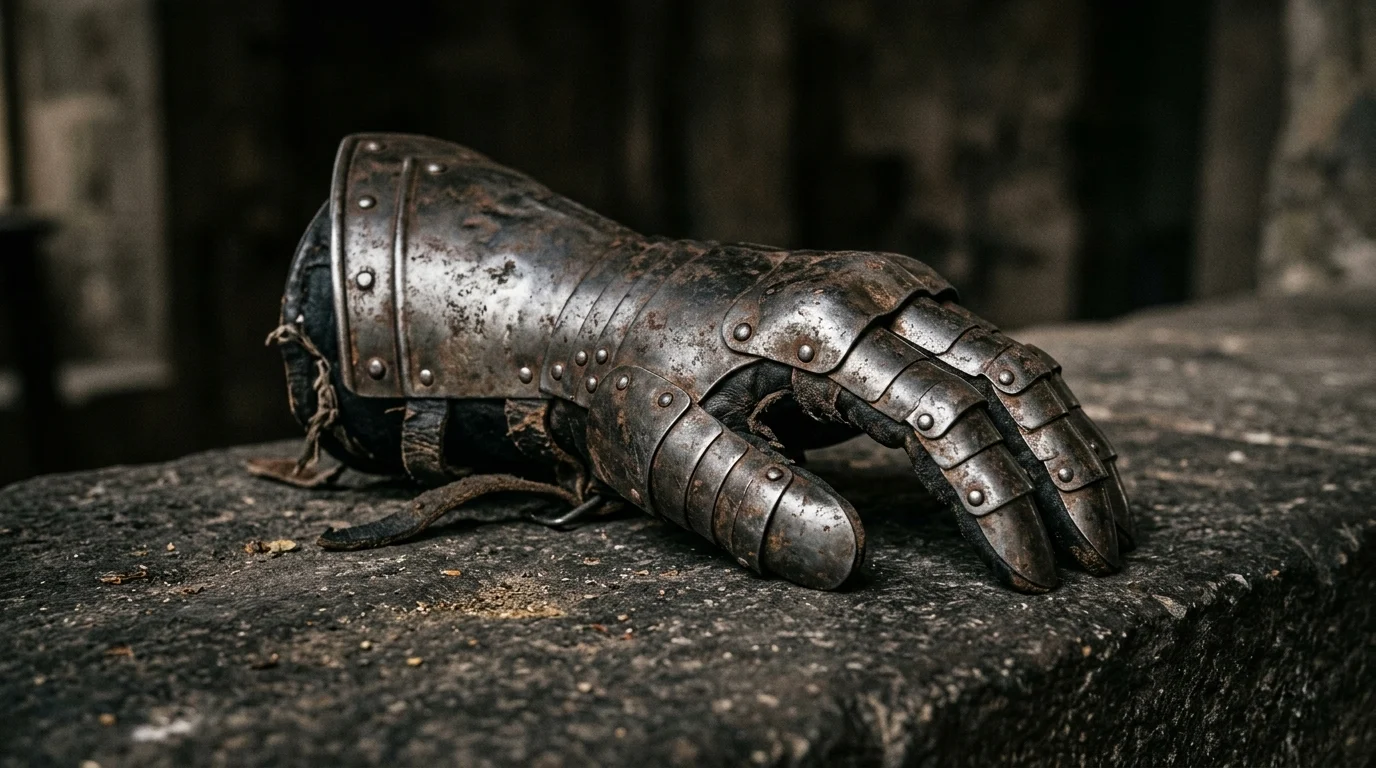
The gauntlet as a piece of armor protected a knight’s hand and forearm in battle. Medieval gauntlets were sometimes made of chain mail, sometimes leather covered with metal plates, and by the fourteenth century, articulated steel plates covering the hand and fingers . The glove extended past the wrist, offering protection that ordinary gloves could not.
The Origin of “Throw Down the Gauntlet”
The idiom comes directly from medieval combat conventions. When a knight wished to challenge another to combat, he would remove his gauntlet and throw it at his rival’s feet. If the challenged knight intended to accept, he would pick the glove up. This gesture transformed an ordinary piece of armor into a symbol of formal challenge .
Modern usage preserves this symbolism. To “throw down the gauntlet” is to issue a challenge, often publicly and with confidence. A company might throw down the gauntlet to its competitors. A politician might throw down the gauntlet to an opponent. The phrase carries a tone of defiance and readiness for conflict.
Modern Protective Gauntlets
Outside of medieval history and figurative language, gauntlets remain practical objects. Industrial workers wear protective gauntlets to shield their hands from heat, chemicals, or machinery. These gloves often extend beyond the wrist, echoing the design of their armored ancestors .
The Ordeal: “Running the Gauntlet”
The second meaning of gauntlet describes a form of punishment in which a person is forced to run between two rows of men who strike at them with clubs, whips, or switches as they pass . This practice, known historically as “running the gauntlet,” was a military punishment in various European armies.
The word for this practice entered English from Swedish gatlopp, meaning “a running down a lane” or “passageway” . The Swedish term described the physical arrangement: the victim ran down a “lane” formed by two lines of attackers. English adopted the word and eventually spelled it the same way as the glove, despite the unrelated origin.
From Punishment to Metaphor
The figurative meaning of “running the gauntlet” has largely overshadowed the literal punishment. To run the gauntlet today means to face a series of difficulties, criticisms, or attacks. A politician might run the gauntlet of hostile reporters. A new employee might run the gauntlet of difficult coworkers. A proposed policy might run the gauntlet of legislative committees .
This metaphorical usage captures the essence of the original punishment: moving forward while being struck from both sides. The person running the gauntlet cannot stop or turn aside; they must endure the blows to reach the other end.
Gauntlet vs. Gantlet: A Spelling Note
Some American writers and dictionaries distinguish between the two meanings by spelling the ordeal sense as gantlet. Merriam-Webster lists gantlet as a less common variant of gauntlet . However, this distinction is not universally observed, and most modern usage employs gauntlet for both meanings.
The Canadian Language Portal notes that the two meanings have separate origins but acknowledges that both are now commonly spelled gauntlet . For most purposes, using gauntlet for both the glove and the ordeal is acceptable and widely understood.
How to Use Gauntlet Correctly
In the Glove Sense
Use gauntlet to describe a protective glove, whether medieval or modern. “The knight’s gauntlet was dented from the blow” or “The welder wore thick gauntlets” are both correct.
In the Challenge Idiom
“Throw down the gauntlet” means to issue a challenge. “Pick up the gauntlet” or “take up the gauntlet” means to accept one. These phrases are standard in English and require no explanation for most readers .
In the Ordeal Idiom
“Run the gauntlet” means to endure a difficult series of attacks, criticisms, or trials. The phrase is usually used with the definite article (“the gauntlet”) and the verb “run.” “She ran the gauntlet of public scrutiny” is a typical example .
Common Mistakes to Avoid
- Do not confuse the two idioms. “Throw down the gauntlet” is about challenge; “run the gauntlet” is about suffering. Mixing them (“throw down the ordeal” or “run the challenge”) produces confusion.
- Do not assume “gantlet” is the only correct spelling for the ordeal. While some style guides prefer it, gauntlet is widely accepted for both meanings .
- Avoid using “gauntlet” casually for minor difficulties. The word carries weight. A small inconvenience is not a gauntlet.
Gauntlet in Popular Culture
The word appears frequently in media, often in its figurative senses. Sports commentators describe athletes as “running the gauntlet” of a tough schedule. Business publications report that companies are “throwing down the gauntlet” to competitors. Fantasy and historical fiction keep the literal armored gauntlet alive in descriptions of knights and battles.
The gauntlet also appears in video games and tabletop role-playing games, where it often denotes a series of challenging encounters or a trial by combat. This usage draws on both the ordeal sense and the challenge sense, blending them into a single concept of testing.
Frequently Asked Questions
1. What is the simple definition of gauntlet?
A gauntlet is a protective glove, especially one worn with medieval armor or in industrial work. The word also appears in idioms meaning to issue a challenge (“throw down the gauntlet”) or to endure a difficult ordeal (“run the gauntlet”) .
2. What does “throw down the gauntlet” mean?
It means to issue a challenge, often publicly. The phrase comes from the medieval practice of a knight throwing his glove at a rival’s feet to challenge him to combat .
3. What does “run the gauntlet” mean?
It means to endure a difficult series of attacks, criticisms, or trials. The phrase originates from a historical punishment in which a person was forced to run between two rows of men who struck at them .
4. Is it “gauntlet” or “gantlet”?
Both spellings exist. Some American style guides use gantlet for the ordeal sense and gauntlet for the glove sense. However, gauntlet is widely accepted for both meanings in modern usage .
5. Where does the word gauntlet come from?
The glove sense comes from Middle French gantelet, meaning “glove.” The ordeal sense comes from Old Swedish gatlopp, meaning “a running down a lane.” The two words converged in spelling in English .
6. Can gauntlet be used outside of medieval or military contexts?
Yes. Modern gauntlets are protective gloves used in industry. The idioms “throw down the gauntlet” and “run the gauntlet” are used in business, politics, sports, and everyday speech .
Conclusion
Gauntlet is a word of two histories. One history begins with a knight’s armored glove, a symbol of protection and challenge. The other begins with a brutal punishment, a test of endurance under attack. English has brought these histories together under a single spelling, and modern usage freely draws on both.
Whether you encounter a gauntlet in a museum, a welding shop, a business negotiation, or a political scandal, the word points toward something demanding. It asks for courage, endurance, or both. Understanding its origins makes its idioms richer and its meanings clearer.