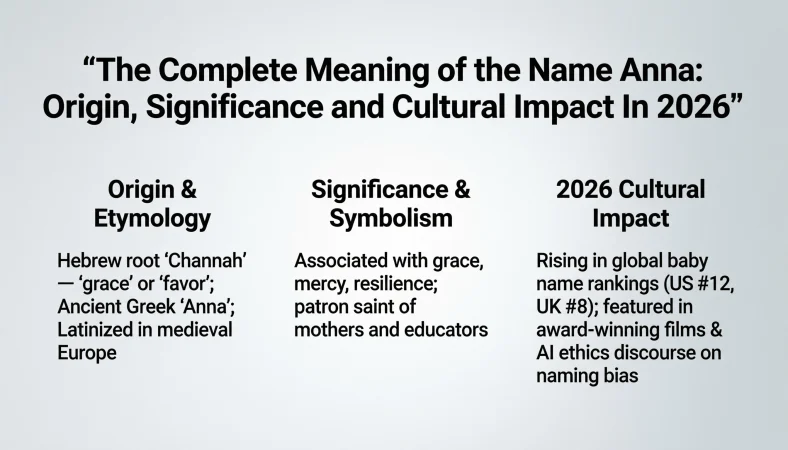
Anna is a feminine name of Hebrew origin that means “grace” or “favor.” It comes from the name Hannah and symbolizes kindness, blessing, and divine grace.
Names carry profound significance they shape identity, reflect cultural heritage, and often hold deep spiritual meaning. Few names have maintained such consistent global appeal and rich historical significance as Anna. If you’ve ever wondered, “what does the name Anna mean?” you’re not alone. This question has intrigued expectant parents, historians, linguists, and individuals curious about their own name’s origins.
The name Anna stands as one of the most timeless and universally recognized feminine names across cultures. From biblical narratives to modern popular culture, Anna has maintained a presence that transcends geographical and linguistic boundaries. Whether you’re considering naming your child Anna, researching your own name’s background, or simply satisfying intellectual curiosity, understanding the full depth of this name’s meaning offers fascinating insights.
In this comprehensive guide, we’ll explore everything about the name Anna its Hebrew origins, biblical connections, cultural variations, personality associations, historical significance, and modern-day relevance. We’ll examine how the name has evolved across languages, its appearance in literature and media, and why it continues to resonate with parents worldwide.
By the end of this article, you’ll have a complete understanding of what the name Anna means, its rich heritage, and the various contexts in which it carries special significance.
Quick Answer Box
| Attribute | Details |
| Meaning | Grace, favor, God has favored me |
| Origin | Hebrew (from Hannah/Channah) |
| Gender | Primarily feminine |
| Pronunciation | AN-uh (English), AHN-nah (European) |
| Biblical Reference | Prophetess in Luke 2:36-38 |
| Variations | Ana, Anne, Ann, Hannah, Anya |
| Popularity | Consistently top 100 globally; #48 in US (2023) |
| Associated Traits | Graceful, kind, intuitive, spiritual, loyal |
What Does the Name Anna Mean?
Core Definition
The name Anna fundamentally means “grace” or “favor.” This meaning stems from its Hebrew root, where it signifies divine kindness, elegance, and spiritual blessing. When someone asks “what does the name Anna mean?” the most direct and widely accepted answer is “grace” a quality that encompasses beauty, kindness, and unmerited divine favor.
The Biblical Connection
In the Christian Bible, Anna appears in the Gospel of Luke as a prophetess and widow who recognizes the infant Jesus as the Messiah when his parents present him at the Temple. The scripture describes her as:
“Anna, a prophetess, the daughter of Phanuel, of the tribe of Asher. She was advanced in years… She did not depart from the temple, worshiping with fasting and prayer night and day.” (Luke 2:36-38)
This biblical figure exemplifies the name’s spiritual significance: a woman of deep faith, wisdom, and devotion. Her recognition of Jesus marks her as one of the first witnesses to the Messiah’s arrival.
The Hebrew Origin: From Hannah to Anna
The name Anna derives from the Hebrew name Channah (חַנָּה), most commonly known as Hannah in English translations. The Hebrew root “chanan” (חנן) means “to be gracious,” “to show favor,” or “to bestow kindness.” The name’s evolution follows a clear linguistic path:
- Original Hebrew: Channah (חַנָּה) “grace,” “favor”
- Greek Translation: Anna (Ἄννα) used in the Septuagint and New Testament
- Latin Adoption: Anna preserved in Vulgate translation
- Modern Languages: Anna (English, Spanish, Italian, German, Scandinavian) and Hannah (common English alternative)
This linguistic journey explains why the name appears in various forms across different cultures while maintaining its essential meaning and spiritual resonance.
The Full Expression: “God Has Favored Me”
The complete meaning of the name Anna expands beyond simply “grace” to express “God has shown favor” or “God has been gracious.” This interpretation reflects the name’s theistic origins and the cultural importance of naming children as expressions of faith and gratitude.
In biblical tradition, names often conveyed prophetic significance or commemorated divine intervention. The name Anna/Hannah represents this practice acknowledging God’s grace in the child’s birth and life.
Context and Usage of the Name Anna
Cultural Significance Across the World
One of the most remarkable aspects of the name Anna is its universal cultural acceptance. Unlike many names that remain confined to specific linguistic or geographical regions, Anna appears in virtually every European language and has spread globally through Christian tradition, colonialism, and cultural exchange.
In Western Cultures:
- English-speaking countries: Anna remains a classic choice, often seen as sophisticated yet approachable
- Spanish-speaking cultures: Ana (without the extra ‘n’) is ubiquitous, frequently paired with María
- Italian culture: Anna is deeply traditional, associated with saints and religious devotion
- German and Scandinavian regions: Anna is one of the most common feminine names historically and currently
In Eastern and Orthodox Traditions:
- Russian culture: Anna (Анна) has been a royal name, associated with empresses and literary heroines
- Greek Orthodox tradition: Honoring Saint Anna, the mother of Mary, making the name particularly sacred
- Middle Eastern Christian communities: Anna maintains its biblical importance
This cultural universality means the name Anna adapts effortlessly to different linguistic pronunciations while preserving its identity.
Historical Popularity Through the Centuries
The name Anna has never truly fallen out of favor. Historical records demonstrate its consistent presence:
- Middle Ages: Popularized through devotion to Saint Anna (traditionally considered Mary’s mother)
- Renaissance Period: Common among nobility and merchant classes across Europe
- 18th-19th Centuries: Featured prominently in literature (Anna Karenina) and among royalty
- 20th Century: Maintained steady popularity, with slight fluctuations
- 21st Century: Continues as a top choice; ranked #48 in US popularity (2023)
This enduring popularity stems from multiple factors:
- Religious significance across Christian traditions
- Simple, elegant pronunciation in multiple languages
- Positive meaning associated with grace and favor
- Flexibility in pairing with middle names
- Cultural neutrality that transcends borders
The Name’s Position in Modern Naming Trends
Modern naming trends often cycle between distinctive names and classic choices. Anna represents the enduring appeal of classic names that feel both traditional and fresh, familiar yet dignified.
Contemporary parents choose Anna for various reasons:
- Its international versatility (suitable for multicultural families)
- Its professional credentials (age-appropriate from childhood through adulthood)
- Its middle-name compatibility (Anna pairs beautifully with almost anything)
- Its nickname potential (Annie, Ann, Nia, or simply Anna)
- Its classic yet not overly common status
Real-Life Examples of the Name Anna in Action
Famous Annas Throughout History
Understanding what the name Anna means becomes more tangible when examining notable figures who’ve borne the name:
Anna Pavlova (1881-1931): Russian prima ballerina, known for her ethereal grace perfectly embodying the name’s meaning through artistic elegance.
Anna Akhmatova (1889-1966): Influential Russian poet whose work reflected resilience, faith, and human dignity through political turmoil.
Anna May Wong (1905-1961): First Chinese-American Hollywood actress, breaking racial barriers and bringing sophistication to screen.
Anna Frank (1929-1945): Though typically known as Anne, her diary represents hope, grace, and humanity in the face of unimaginable suffering.
Anna Wintour (1949-present): Influential editor-in-chief of Vogue, representing strength, sophistication, and professional grace.
Anna Kendrick (1985-present): Contemporary actress and singer, embodying the name’s approachable yet talented character.
Literary and Cultural Annas
The name Anna has inspired countless literary characters:
- Anna Karenina: Tolstoy’s tragic heroine one of literature’s most complex female characters
- Anna of the Five Towns: Arnold Bennett’s novel about a woman constrained by societal expectations
- Anna of Green Gables: Though the protagonist is Anne, the name’s similar form represents warmth and charm
- Anna in Frozen: The Disney princess who exemplifies love, courage, and sisterly devotion
Each character adds dimension to the name’s cultural meaning, associating it with strength, grace, and emotional depth.
Platform-Specific Usage and Context
Professional and Formal Environments
In professional contexts, Anna commands respect and recognition. The name projects:
- Competence: Its classic nature suggests reliability
- Approachability: The soft sounds make it welcoming
- Authority: Historical associations lend dignity
- Global recognition: Works across international business settings
Academic and Educational Settings
Anna appears frequently in academic environments, projecting intelligence and scholarly aptitude. The name’s simplicity aids memorability while its classic status suggests academic tradition.
Social and Personal Scenarios
In personal relationships, Anna communicates warmth, dependability, and grace. The name’s gentle sound aligns with perceptions of kindness and emotional intelligence.
Alternative Meanings and Interpretations
Numerological Significance
In numerology, the name Anna corresponds to specific numbers that hold spiritual meaning:
| Aspect | Number | Significance |
| Life Path | 1 | Leadership, independence, originality |
| Soul Urge | 2 | Cooperation, balance, sensitivity |
| Personality | 8 | Authority, material abundance, power |
These numerological associations complement the name’s spiritual origin, suggesting someone who balances grace with ambition.
Astrological and Zodiac Connections
While not directly tied to specific zodiac signs, the name Anna often appears in contexts suggesting:
- Moon influences: Emotional depth and intuition
- Venus associations: Love, beauty, and harmony
- Water signs: Emotional intelligence and adaptability
Psychological Associations
Psychological interpretations of the name Anna include:
- Warmth: The soft consonant and vowel combination suggests approachability
- Trustworthiness: Classic names typically project reliability
- Feminine strength: Grace combined with resilience
- Spiritual awareness: Biblical connections suggest moral depth
Related Terms and NLP Variations
Common Variations and Diminutives
The name Anna has spawned numerous variations across languages:
| Variation | Origin/Language | Distinction |
| Ana | Spanish, Portuguese, Slavic | Single ‘n’ version |
| Anne | French, English | Less common but classic |
| Ann | English | Shortened form |
| Anya | Russian, Irish | Softened variant |
| Anni | Finnish, German | Endearing form |
| Annie | English | Informal, affectionate |
| Annette | French | Extended form |
| Annika | Scandinavian | Swedish/Norwegian variant |
| Hannah | Hebrew/English | Original Hebrew form |
Semantic Relationships
The name Anna connects semantically to:
- Grace: The core meaning
- Favor: Alternative translation
- Blessing: Contextual interpretation
- Mercy: Extended meaning from the root
Frequently Paired Middle Names
Anna pairs beautifully with various middle names, often chosen to complement its grace-themed meaning:
- Anna Grace (emphasizing the meaning)
- Anna Marie (traditional religious pairing)
- Anna Rose (floral elegance)
- Anna Louise (classic combination)
- Anna Victoria (strength and grace)
- Anna Catherine (regal pairing)
How to Respond to “What Does Your Name Mean?”
Simple Explanations
When asked “what does your name mean?” an Anna can respond:
- “It means grace or favor, from Hebrew origins.”
- “It’s a biblical name meaning ‘God has favored me.'”
- “It comes from the Hebrew name Hannah and means grace.”
Conversation Examples
Scenario 1: Casual Introduction
Friend: “What does the name Anna mean?”
Anna: “It comes from Hebrew and means grace. My parents chose it because they liked the biblical connection and the meaning.”
Friend: “That’s beautiful! You definitely embody grace.”
Scenario 2: Professional Setting
Colleague: “I’ve always wondered does your name have a special meaning?”
Anna: “Yes! It’s Hebrew for grace or favor. It’s a very old name that appears in the Bible.”
Colleague: “I love that. It suits you.”
Scenario 3: Cultural Discussion
International colleague: “In my country, Anna is also a common name. Is the meaning different where you’re from?”
Anna: “Actually, the meaning is pretty consistent across cultures. It’s originally Hebrew for grace, and the translation carries across most languages.”
Colleague: “That’s so interesting! It really is universal.”
Scenario 4: Parenting Decision
Expectant mother: “My husband and I are considering naming our daughter Anna. What does it mean to you?”
Anna: “To me, it’s always felt like a name that carries quiet strength and grace. I’ve always appreciated its classic simplicity and the fact that it works anywhere in the world.”
Expectant mother: “That’s exactly what we’re looking for.”
Scenario 5: Deeper Conversation
Friend: “Do you feel your name fits you?”
Anna: “Honestly, yes. I love that it means grace because I try to approach life with kindness and dignity. Plus, there’s something special about sharing a name with such a significant biblical figure.”
Friend: “I can definitely see that in you.”
Misinterpretations and Common Mistakes
Historical Misunderstandings
The Anna/Hannah Distinction: Many people mistakenly believe Anna and Hannah are entirely different names. In reality, Hannah is the original Hebrew form, while Anna is the Greek/Latin adaptation. They’re essentially different pronunciations of the same name.
Source Confusion: Some think Anna only appears in the New Testament. However, the name’s origin as Hannah makes it equally significant in Jewish and Christian traditions.
Meaning Misattribution: Occasionally, people confuse Anna’s meaning with “favor” without understanding its full theological significance of “divine favor” or “God’s grace.
Pronunciation Variations
Regional pronunciations differ significantly:
- English: AN-uh (soft ‘a’)
- Spanish: AHN-nah (open ‘a’ sounds)
- Italian: AHN-nah (rolled ‘n’)
- German: AH-nah (guttural ‘h’)
- Russian: Ahn-NAH (stress on second syllable)
These variations don’t change the meaning but affect how the name feels in different cultural contexts.
Gender Confusion
While Anna is overwhelmingly feminine, related variations exist:
- Anas: Masculine form in some Arabic contexts
- Ann: Occasionally used for males historically
- Anno: Masculine in some Germanic traditions
However, in English and most Western contexts, Anna remains exclusively feminine.
When Not to Use the Name Anna
While Anna works beautifully in most contexts, consider these scenarios:
Potential Challenges
Cultural Insensitivity: While rare, the name might feel culturally appropriative in contexts where:
- The family has no religious or cultural connection to its Hebrew origins
- The name’s Christian associations conflict with the family’s religious identity
Pronunciation Struggles: In languages with different phonetic systems, pronunciation may vary significantly, potentially causing frustration for the individual.
Overused in Some Regions: In certain areas, Anna may be perceived as too common or lacking distinction.
Alternative Considerations
If the meaning resonates but Anna isn’t quite right, consider:
- Grace: The meaning itself as a name
- Hannah: The original Hebrew form
- Annika: Scandinavian variation
- Anastasia: Similar sound, different meaning (“resurrection”)
Usage Tips for Parents Considering Anna
Decision-Making Factors
Meaning Importance: If spiritual significance matters to you, Anna’s biblical roots offer depth and tradition.
Cultural Fit: Consider how the name works:
- In your family’s cultural context
- In your community
- In your professional sphere
Sibling Compatibility: Anna pairs well with:
- Classic names (James, William, Charlotte, Elizabeth)
- Modern names (Noah, Emma, Oliver, Sophia)
- Cultural names from various backgrounds
Nickname Potential: Consider whether you like:
- Annie (playful, youthful)
- Ann (simple, classic)
- Nia (modern, distinctive)
- Ana (international feel)
Long-Term Considerations
Professional Impact: Anna projects competence and seriousness while remaining approachable ideal across career stages.
Age Appropriateness: The name works equally well for:
- Infants (sweet and gentle)
- Young adults (respectable and confident)
- Seniors (timeless and dignified)
Global Mobility: If your child may live internationally, Anna’s worldwide recognition is a significant advantage.
The Spiritual and Emotional Significance of Anna
The Name as Identity
Names shape identity in subtle but powerful ways. For those named Anna, the meaning of “grace” often influences:
- Self-perception: Feeling connected to qualities of kindness and elegance
- Expectations: Striving to embody the name’s positive attributes
- Belonging: Connection to a rich historical and spiritual tradition
Grace as a Guiding Principle
The concept of grace extends beyond a simple definition:
- Spiritual grace: Divine favor and blessing
- Social grace: Elegance, poise, and kindness in interaction
- Personal grace: Resilience, forgiveness, and dignity
- Artistic grace: Beauty, harmony, and aesthetic refinement
Each interpretation offers women named Anna a framework for personal development and self-understanding.
FAQs
1. What does the name Anna mean?
Anna means “grace” or “favor” and comes from the Hebrew name Hannah.
2. Is Anna a biblical name?
Yes, Anna appears in the Bible as a prophetess in the Gospel of Luke.
3. Are Anna and Hannah the same name?
Yes, Hannah is the Hebrew form, while Anna is the Greek and Latin variation.
4. Is Anna still a popular name?
Yes, Anna remains a timeless and popular name worldwide.
5. Does Anna have a religious meaning?
Yes, the name is strongly connected to faith, grace, and divine favor in Christian and Jewish traditions.
6. What names are similar to Anna?
Names like Hannah, Anne, Ana, Annabelle, and Anastasia are closely related.
7. Can Anna be used as a nickname?
Yes, Anna can be short for names like Anastasia or Annabelle, but it is also a complete name on its own.
8. Is Anna a modern or classic name?
Anna is a classic name with ancient roots that still feels modern today.
Conclusion
Anna is a simple yet powerful name with deep historical, biblical, and cultural roots. Its meaning grace and favor has stayed consistent for centuries, making it one of the most timeless names in the world. Whether chosen for its beauty, faith-based significance, or global appeal, Anna remains a strong and elegant choice that continues to stand the test of time.