Quick Answer: Calvary refers to the hill outside Jerusalem where Jesus was crucified, also known as Golgotha, meaning “place of the skull.” In broader usage, the word describes any experience of intense suffering or a sculptural representation of the crucifixion.
Calvary carries a weight that few other words in English can match. For most readers, it immediately evokes the central event of the Christian narrative—the crucifixion of Jesus Christ on a hill outside ancient Jerusalem. Yet the word has traveled far beyond its original geographic and religious boundaries, appearing in literature, art, and everyday speech as a metaphor for profound hardship.
Understanding Calvary requires attention to three overlapping layers: its literal meaning as a place name, its symbolic role in Christian theology, and its secular life as a term for suffering. Each layer informs the others, and together they explain why this word has remained relevant for over a thousand years.
What Does Calvary Mean?
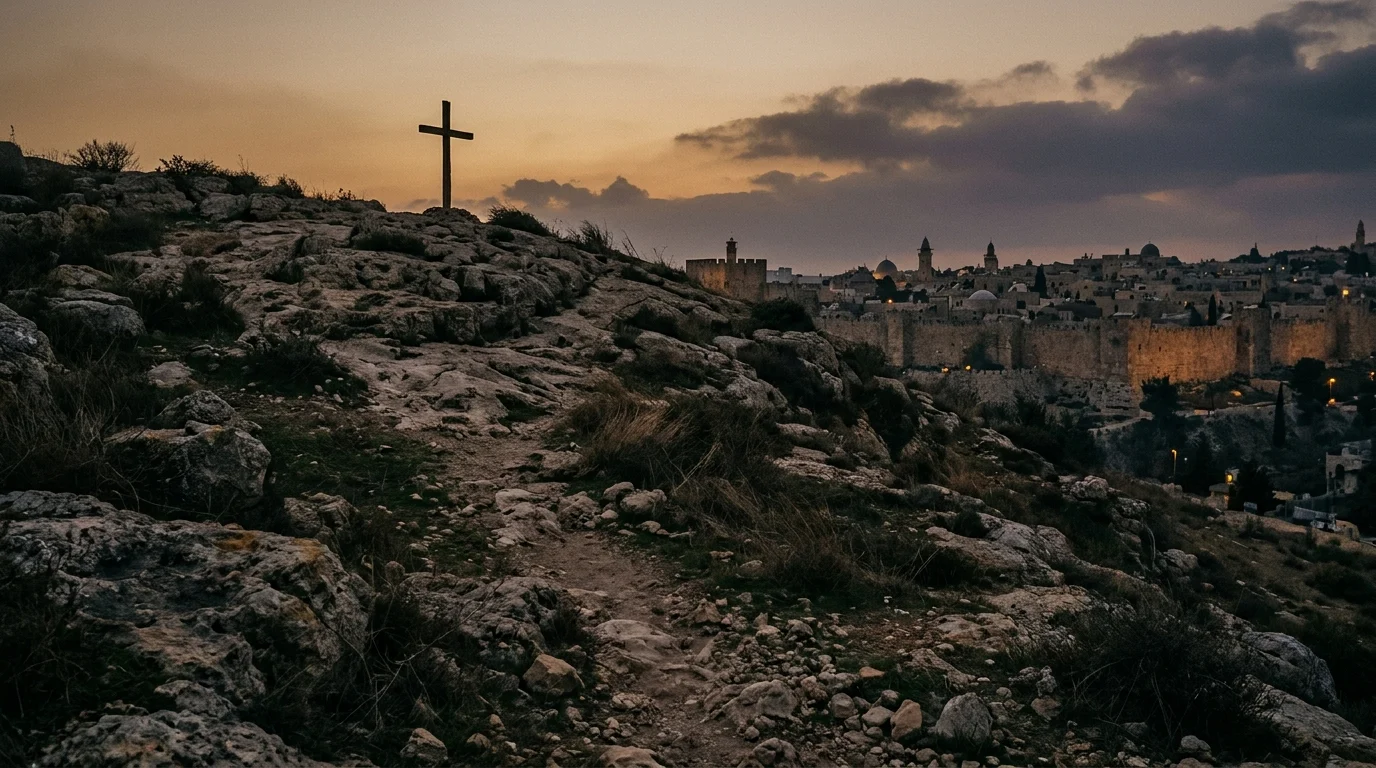
At its core, Calvary names the hill just outside the walls of Jerusalem where Jesus was crucified . The Cambridge Dictionary defines it simply as a reference to this specific location . The name derives from the Latin word calvaria, meaning “skull,” which itself translates the Aramaic name Golgotha .
Beyond this literal meaning, Calvary has developed two additional senses. First, it can refer to a sculptured representation of the crucifixion, typically erected outdoors . Second, and more commonly in modern usage, it describes an experience of extreme suffering, especially mental or emotional anguish .
Pronunciation
British English: /ˈkæl.vər.i/ (KAL-vuh-ree)
U.S. English: /ˈkæl.vər.i/ (KAL-vuh-ree)
Word Origin
Calvary entered English over a thousand years ago as the name of the crucifixion site . It comes from Late Latin Calvaria, which translates the Greek kranion and the Aramaic Golgotha, both meaning “skull” . The capitalization distinguishes the place name from the lower-case common noun meaning suffering or a sculpture .
The Biblical and Historical Background
The Gospels describe Calvary as the site of Jesus’s execution. According to the Church of Jesus Christ of Latter-day Saints’ Bible Dictionary, Calvary is “merely an English form of the Latin word calvaria, which is itself a translation of the Hebrew word Golgotha, ‘a skull’” . Importantly, this source notes that the popular expression “Mount Calvary” has no basis in the Gospel accounts, which never mention a mountain .
The location’s name likely derived either from the skull-like appearance of the hill or from its association with executions. In Christian theology, Calvary represents the culminating moment of the crucifixion narrative—the place where Jesus suffered and died before the resurrection. For pilgrims and theologians alike, it has long been treated as a focal point of spiritual geography.
Calvary as the Center of the World
Some early Christian writers went further than treating Calvary as a significant site. They positioned it as the cosmic center of the world. Victorinus of Pettau, writing around 303 CE, described Calvary as “the place which is thought of as the centre of the world” . Cyril of Jerusalem in the fourth century argued the same point, citing Psalm 74:12: “He is working salvation in the midst of the earth” . Jerome later called Calvary the “navel of the world” . These interpretations reflect the site’s immense theological importance in early Christianity.
Calvary Across Languages and Traditions
The word has equivalents in many languages, most of them derived from the same Latin root.
| Language | Form | Notes |
|---|---|---|
| Spanish | Calvario | Standard translation |
| French | Calvaire | Used in religious and literary contexts |
| German | Kalvarienberg | Literally “Calvary mountain” |
| Italian | Calvario | Common form |
| Portuguese | Calvário | Standard translation |
| Russian | Калвария | Transliteration of the Latin root |
| Chinese | 各各他山 | Transliteration of Golgotha |
Sources: Khandbahale dictionary compilation .
Golgotha and Calvary: Same Place, Different Names
Golgotha comes from the Aramaic word for skull, while Calvary comes from the Latin translation of that same term. The Easy English Bible Dictionary explains that Calvary means “the place where they killed Jesus on a cross of wood” and that “the word means skull” . Both names refer to the same location; the choice between them often depends on linguistic tradition rather than theological difference.
Calvary vs. Cavalry: The Most Common Confusion
No discussion of Calvary is complete without addressing its most persistent linguistic problem. Calvary and cavalry are frequently confused, and the error appears often enough that Merriam-Webster includes Calvary’s pronunciation as a nonstandard variant of cavalry .
The difference is stark. Cavalry refers to soldiers mounted on horseback, or more broadly to mobile military units . It comes from the Italian cavalleria, related to horses. Calvary, by contrast, refers to the crucifixion site or to intense suffering . The two words share no etymological connection.
Merriam-Webster offers a memorable distinction: “cavalry is quite often mobile, and so may readily be sent, or may be coming; the calvary comes from the name of the hill near Jerusalem where Jesus was crucified, and is not something that may be sent in” . In other words, you call in the cavalry for help; you do not call in the calvary.
A Simple Memory Trick
The word dealing with horsemen contains “val” in the middle. Associating cavalry with Prince Valiant, who occasionally appears on horseback, helps cement the correct choice . Alternatively, remember that “Cavalry is for Cowboys, Calvary for Christ” .
Calvary as a Symbol of Suffering
The figurative use of Calvary—meaning a place or experience of great suffering—emerged in the 18th century. Merriam-Webster traces the development: after Calvary began to be used for “an open-air representation of the crucifixion,” it later took on the sense of “an experience of usually intense mental suffering” .
This secular meaning appears in literature, journalism, and everyday speech. A person might describe a difficult illness, a grueling legal battle, or a period of grief as “a personal Calvary.” The usage carries religious overtones even when the speaker has no explicitly religious intent. The word implies suffering that is prolonged, significant, and often endured with some measure of dignity or purpose.
When to Use Calvary Figuratively
The figurative sense works best when the suffering in question is substantial rather than trivial. Describing a minor inconvenience as a Calvary would sound hyperbolic or ironic. The term carries weight, and it should be used with awareness of that weight.
How to Use Calvary Correctly
As a Proper Noun
When referring to the historical location, capitalize Calvary. “The pilgrims visited Calvary” or “The Church of the Holy Sepulchre marks the traditional site of Calvary” are correct examples.
As a Common Noun
When referring to a sculpture or an experience of suffering, use lowercase. “The garden contained a calvary” or “His final years were a calvary of pain” follow this pattern .
Common Mistakes to Avoid
- Do not confuse Calvary with cavalry. The words are unrelated in meaning and origin. Sending in the calvary is an error; sending in the cavalry is correct.
- Do not assume Calvary is a mountain. The Gospels never describe it as a mount, and the Bible Dictionary explicitly notes that “Mount Calvary” is not warranted by the text .
- Avoid using Calvary lightly. The word’s religious and historical associations give it a gravity that makes it unsuitable for minor complaints.
Famous References to Calvary
Calvary has appeared in hymns, literature, and art for centuries. The hymn “The Old Rugged Cross” references Calvary directly. John Bunyan’s Pilgrim’s Progress includes a scene at a cross that interpreters have connected to Calvary. In classical music, Bach’s St. Matthew Passion depicts the crucifixion at Golgotha.
The word also appears in place names. Churches, cemeteries, and monasteries around the world bear the name Calvary, reflecting its enduring significance in Christian communities. Calvary Chapel, a network of churches originating in California, has spread internationally.
Frequently Asked Questions
1. What is the simple definition of Calvary?
Calvary is the hill outside Jerusalem where Jesus was crucified. The word also refers to a representation of the crucifixion or to any experience of intense suffering .
2. Is it Calvary or cavalry?
Calvary refers to the crucifixion site or to suffering. Cavalry refers to mounted soldiers. The two words are unrelated and should not be confused .
3. Why is Calvary called “the place of the skull”?
The name derives from the Latin calvaria and the Aramaic Golgotha, both meaning “skull.” The location may have been named for its appearance or for its association with executions .
4. Is Calvary a mountain?
The Gospels do not describe Calvary as a mountain. The phrase “Mount Calvary” is a later tradition not supported by the biblical text .
5. What does it mean to call something “a calvary”?
To describe an experience as a calvary means it involved extreme suffering, especially mental or emotional anguish. The usage draws on the religious significance of the crucifixion site .
6. Where is Calvary located today?
The traditional site of Calvary is marked by the Church of the Holy Sepulchre in Jerusalem’s Old City. Other locations have been proposed, but the Holy Sepulchre remains the most widely accepted traditional site.
Conclusion
Calvary is a word that carries the weight of its history. It names a specific place—a hill outside Jerusalem where, according to Christian tradition, Jesus was crucified. It also stands for the suffering that occurred there, and by extension for any suffering that feels overwhelming. The word’s journey from a Latin translation of an Aramaic place name to a common metaphor for human anguish shows how deeply language and belief intertwine.
Whether you encounter Calvary in a church, a poem, or a news article, the word points toward something serious. It asks to be used with care, distinguished from its look-alike cavalry, and understood in light of the story it has carried for two thousand years.