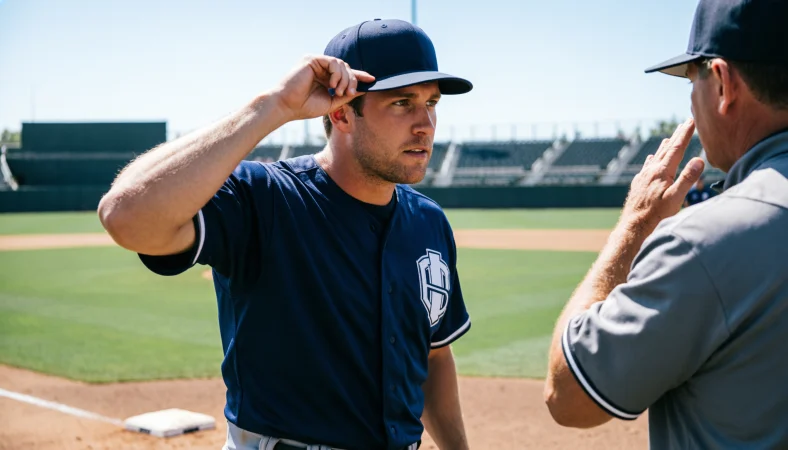
In baseball, tapping the helmet usually means a player is signaling awareness, strategy, or communication with teammates and coaches. It can indicate “I got it,” acknowledge a sign, or be part of a planned play depending on the game situation.
Baseball is full of hidden communication. From hand signals between coaches and players to body language on the field, almost every movement can carry meaning. One action that often confuses fans is when a player taps their helmet.
If you have ever watched a game and wondered, what does tapping helmet mean in baseball, you are not alone. It can look simple, but the meaning changes depending on the moment. Sometimes it is strategic. Sometimes it is personal. Sometimes it is just acknowledgment.
This guide breaks down the full meaning of helmet tapping in baseball, when it is used, what players are trying to communicate, and how it compares to other baseball signals. You will also see real examples, common misunderstandings, and how this gesture fits into modern baseball culture.
Quick Answer Box
| Element | Meaning |
| Meaning | A non-verbal baseball signal or acknowledgment |
| Context | Base running, batting, dugout communication |
| Usage | Confirms signs, shows awareness, signals teammates |
| Platforms | MLB broadcasts, coaching discussions, baseball analysis |
| Example | Runner taps helmet after receiving a steal sign |
| Tone | Strategic, subtle, situational |
What Does It Mean?
In baseball, tapping the helmet generally means a player is acknowledging a signal or communicating silently.
The exact meaning depends on the situation:
- Confirming a coach’s sign
- Saying “I understand”
- Letting teammates know something
- Indicating awareness of game strategy
- Signaling timing on a play
Unlike universal umpire signals, helmet tapping is more flexible. It is often part of a team’s internal communication system.
This makes it important to read the context.
For example:
A runner on second base may tap their helmet after getting a bunt sign. That tap often means they understood the instruction.
A batter may tap their helmet toward the dugout after looking at the coach. That can mean the same thing.
In short, helmet tapping is baseball’s silent “message received.”
Full Definition
Helmet tapping in baseball is a non-verbal acknowledgment gesture, usually involving a batter or base runner lightly touching the top or side of their helmet.
Its purpose is to:
- Reduce verbal communication
- Avoid giving away strategy
- Keep communication quick
- Confirm understanding
Baseball relies heavily on hidden signals because opponents are always watching. Coaches cannot simply yell out every instruction.
That is where body language matters.
A helmet tap can act like:
- A checkmark
- A nod
- A confirmation signal
Think of it as baseball’s version of saying:
- “Got it.”
- “Understood.”
- “I see the sign.”
- “I’m ready.”
Context & Usage
Helmet tapping changes meaning based on the game situation.
During Base Running
This is one of the most common uses.
When a runner is on base, the third base coach often gives signals for:
- Stealing
- Taking off on contact
- Delayed steals
- Hit-and-run plays
- Tagging up
A helmet tap can confirm the runner saw the sign.
Example:
Coach signals steal.
Runner taps helmet.
Coach knows the runner understands.
That keeps everyone synchronized.
At the Plate
Batters also use helmet taps.
This can happen when:
- Receiving signs from the dugout
- Confirming bunt strategy
- Acknowledging a take sign
- Reacting to pitch sequencing
Example:
Coach gives “take the next pitch.”
Batter taps helmet subtly.
This shows the plan is understood.
In the Dugout
Players sometimes tap their helmet toward teammates after a big play.
This can mean:
- Respect
- Recognition
- “Good read”
- “Nice call”
This is less formal but still meaningful.
Defensive Communication
Rarely, fielders may tap helmets during pre-pitch positioning.
This is often internal team code.
Not universal.
Real-Life Examples
Here are practical game scenarios.
Example 1: Steal Sign
Coach: “Watch for the second motion.”
Runner: taps helmet
Meaning: I understand the timing.
Example 2: Hit-and-Run
Coach flashes sign.
Runner on first taps helmet.
Meaning: Ready to run when the pitch comes.
Example 3: Bunt Play
Batter looks at third base coach.
Touches helmet.
Meaning: I got the bunt sign.
Example 4: Take Sign
Manager signals patience.
Batter taps helmet before stepping in.
Meaning: Taking first pitch.
Example 5: Decoy Signal
Coach gives multiple fake signs.
Player taps helmet after real sign.
Meaning: Confirming the correct sequence.
Platform-Specific Meaning
While baseball is the same everywhere, discussions about helmet tapping vary across media platforms.
YouTube Baseball Breakdowns
On baseball analysis videos, helmet taps are often pointed out during:
- Replay breakdowns
- Coaching analysis
- Base stealing tutorials
Analysts explain hidden strategy fans miss live.
Example:
“This helmet tap tells the coach he’s stealing on first movement.”
X Baseball Discussions
Fans often ask:
“Why did he tap his helmet?”
Sports accounts explain whether it was:
- Strategy
- Signal acknowledgment
- Celebration
TikTok Baseball Clips
Short baseball clips often highlight weird gestures.
Helmet taps sometimes go viral when fans think they mean something bigger.
But context matters.
Reddit Baseball Forums
Baseball communities frequently debate:
- Was that a steal sign?
- Was it a hit-and-run?
- Did the batter miss the sign?
This helps newer fans learn.
Alternative Meanings
Not every helmet tap means strategy.
Sometimes it can mean something else.
Personal Habit
Some players tap their helmet out of routine.
Baseball is full of rituals.
Examples:
- Adjusting gloves
- Tapping cleats
- Touching helmet
This may have zero strategic meaning.
Equipment Adjustment
A loose helmet may cause a quick tap.
No signal involved.
Celebratory Gesture
After a hit or home run, a player may tap their helmet toward the dugout.
This can mean:
- Thanks
- Respect
- Recognition
Hidden Team Code
Some teams create unique meanings.
For example:
- One tap = steal
- Two taps = bunt
- Side tap = fake bunt
These are private systems.
Related Terms / NLP Variations
People search for this topic using many variations.
Related phrases include:
- what does touching helmet mean in baseball
- baseball helmet tap signal
- why do baseball players tap helmets
- helmet signal in baseball
- baseball player touches helmet meaning
- tapping head in baseball meaning
- baseball hand signals explained
- coach signs in baseball
These all connect to the same core idea: silent strategy.
Related baseball communication terms:
Sign Stealing
Sign stealing is when opponents try to decode signals.
This is why subtle gestures like helmet taps exist.
Hit-and-Run
A coordinated offensive play where the runner starts moving as the batter swings.
Helmet taps may confirm it.
Bunt Sign
A coach instructing a batter to bunt.
Often acknowledged silently.
Take Sign
Telling the batter not to swing.
Another common helmet tap situation.
How to Respond / Reply
If you are playing baseball and receive a signal, your response matters.
Acknowledge Clearly
Use the agreed signal.
Examples:
- Helmet tap
- Nod
- Hand adjustment
Do not overdo it.
Stay Subtle
Opponents watch everything.
Too obvious = risk.
Confirm Timing
Especially for steals.
Mistimed communication can ruin the play.
Trust Team Codes
Every team has its own language.
Stick to it.
Conversation Examples
Here are realistic baseball dialogues.
Conversation Example 1
Coach: “If he goes to his leg twice, steal.”
Runner: taps helmet
Coach: “Perfect.”
Meaning: Signal understood.
Conversation Example 2
Coach: “Safety squeeze.”
Batter: taps helmet and adjusts gloves
Runner: “Ready.”
Meaning: Everyone knows the plan.
Conversation Example 3
Manager: “Take until strike.”
Batter: helmet tap
Catcher throws fastball.
Meaning: Batter stays disciplined.
Conversation Example 4
Coach: “Fake bunt, pull back.”
Batter: tap tap
Pitch comes.
Meaning: Decoy strategy accepted.
Conversation Example 5
Runner: “Was that steal?”
Coach: “Yes, after the curve.”
Runner: helmet tap
Meaning: Timing locked in.
Misinterpretations
Many fans misunderstand helmet tapping.
It Does Not Always Mean Steal
This is the biggest myth.
A tap can mean many things.
It Is Not Universal
Every team uses its own system.
What one team means may differ from another.
It Is Not Always Intentional
Sometimes players simply adjust gear.
Not everything is a coded signal.
TV Angles Can Mislead
Broadcasts may show only part of the interaction.
You might miss the coach’s sign before the tap.
That changes everything.
When NOT to Use It
For players, helmet tapping should not be random.
Avoid it when:
You Have No Team Agreement
Random gestures confuse everyone.
Opponents Are Watching Closely
Predictable patterns can be decoded.
The Situation Requires Immediate Action
Sometimes reacting is faster than signaling.
It Can Be Misread
Especially in youth baseball.
Simple communication may work better.
Usage Tips
If you are learning baseball communication:
Keep Signals Simple
Complicated systems create mistakes.
One tap can be enough.
Practice During Training
Do not invent signals mid-game.
Repetition builds trust.
Change Signals Often
This prevents sign stealing.
Match the Situation
Not every play needs a helmet tap.
Use it only when necessary.
Stay Natural
Forced body language attracts attention.
Blend it into normal movement.
Why Baseball Uses Silent Signals
Baseball is unique because it allows so much strategic communication.
Unlike sports like basketball or football where coaches can shout openly, baseball is slower and more observant.
Everyone can see everything.
That creates the need for hidden systems.
Helmet taps work because they are:
- Quick
- Quiet
- Hard to notice
- Easy to repeat
This makes them effective.
It is lowkey one of the smartest parts of baseball strategy.
How Helmet Tapping Has Evolved
Older baseball relied heavily on obvious hand signals.
Modern baseball changed because of:
- Video replay
- Sign analysis
- Analytics
- Faster scouting
Teams now use layered systems.
Helmet tapping became more common as a confirmation method rather than the main signal.
Today, it often supports bigger communication systems.
For example:
Coach gives signs.
Player confirms with helmet tap.
That extra layer reduces mistakes.
Helmet Tap vs Other Baseball Signals
| Signal | Meaning |
| Helmet tap | Confirmation or acknowledgment |
| Chest touch | Team-specific strategy |
| Belt touch | Often fake sign sequence |
| Arm swipe | Steal or hit-and-run in some systems |
| Eye touch | Watch pitch or timing |
| Cap touch | Defensive alignment |
Helmet taps are among the most subtle.
That makes them valuable.
Youth Baseball vs MLB Usage
Helmet taps appear differently at different levels.
Youth Baseball
More basic.
Usually means:
- Pay attention
- Confirm bunt
- Watch for steal
Simpler systems.
High School Baseball
More advanced.
Includes:
- Decoys
- Multi-step signals
- Delayed timing
College Baseball
Very strategic.
Signals are faster and more complex.
Helmet taps become layered.
Major League Baseball
At the professional level, every gesture matters.
Opponents study tendencies.
Helmet tapping becomes highly situational.
FAQs
What does tapping the helmet mean in baseball?
It usually means acknowledgment of a coach’s signal or confirmation of strategy.
Is helmet tapping always a steal sign?
No. It can mean bunt, take, hit-and-run, or other team-specific plans.
Why do batters tap their helmets?
Often to confirm they received instructions from coaches or dugout staff.
Do MLB players use helmet taps?
Yes, but meanings vary by team and situation.
Can helmet tapping be accidental?
Yes. Sometimes it is just adjusting equipment.
Is it part of official baseball rules?
No. It is an informal communication tool.
Does every team use the same helmet tap meaning?
No. Teams customize signals.
Can opponents figure it out?
Yes. That is why teams rotate signs.
Is helmet tapping common in youth baseball?
Yes, especially for simple coaching communication.
Does tapping the helmet mean “I got it”?
Most of the time, yes.
Conclusion
So, what does tapping helmet mean in baseball?
At its core, it usually means acknowledgment, understanding, or silent communication. It is one of baseball’s many hidden signals that keeps strategy flowing without giving away the plan.
But context is everything.
A helmet tap could mean:
- “I understand.”
- “I’m stealing.”
- “I’m bunting.”
- “Taking this pitch.”
- “Good call.”
Or sometimes, it could mean nothing at all.
That is what makes baseball so fascinating. Small gestures can carry huge meaning. The next time you see a player tap their helmet, watch closely. The real story is often happening before the pitch.