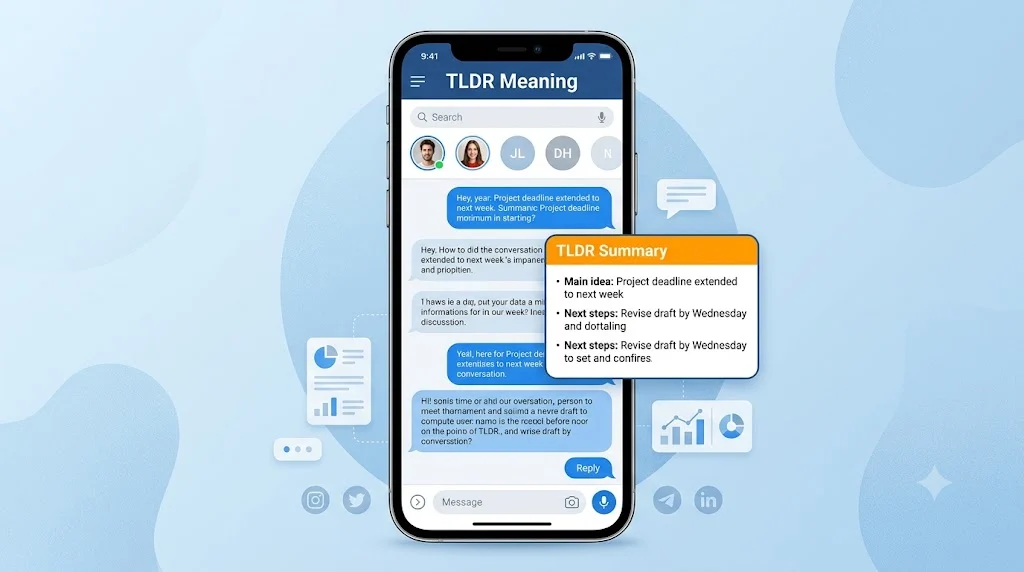
TL;DR stands for “Too Long; Didn’t Read.” It is a popular internet abbreviation used to indicate that a piece of text is very long or to provide a short summary of a longer article, email, post, or discussion.
If you’ve spent time on social media, online forums, or messaging apps, you’ve probably seen TLDR appear at the beginning or end of a post. While it looks simple, this internet abbreviation serves multiple purposes depending on the conversation.
Sometimes it introduces a quick summary after a lengthy explanation. Other times, someone uses it humorously to admit they skipped reading a long message. Because online communication moves quickly, TLDR has become one of the most recognized internet acronyms across platforms.
In this guide, you’ll learn the complete TLDR meaning, where it came from, how people use it today, platform-specific meanings, real conversation examples, alternative interpretations, reply ideas, common mistakes, FAQs, and practical tips for using it naturally.
Quick Answer Box
| Category | Answer |
|---|---|
| Meaning | Too Long; Didn’t Read |
| Purpose | Summarize long information or indicate a message was too lengthy |
| Used On | Reddit, X (Twitter), Facebook, Instagram, TikTok, Discord, Slack, WhatsApp, email, blogs |
| Tone | Casual, informative, humorous |
| Best Example | TLDR: We approved the project and launch starts Monday. |
| Search Intent | Definition, slang meaning, texting meaning, internet abbreviation |
What Does TLDR Mean?
TLDR stands for:
Too Long; Didn’t Read
Originally, people used it as a blunt response to extremely long online posts. Over time, however, the meaning evolved. Today, most writers add “TLDR:” before a short summary to help readers understand the key point quickly.
Instead of sounding rude, TLDR often improves readability because it gives busy readers an instant overview.
For example:
TLDR: The software update fixes bugs, improves battery life, and adds dark mode.
In this example, readers immediately understand the main takeaway before reading the details.
Full Definition
TLDR is both:
- an internet acronym
- a summary label
- a reading shortcut
- a communication tool
- an online writing convention
Today, many articles intentionally include a TLDR section because readers appreciate concise information.
Rather than replacing the full content, the summary highlights the most important ideas.
Therefore, TLDR helps people:
- save time
- understand complex topics quickly
- decide whether to continue reading
- improve online communication
The Origin of TLDR
TLDR appeared during the early days of internet discussion boards and online communities.
Initially, users wrote “Too Long; Didn’t Read” as criticism when someone posted extremely lengthy content.
Later, bloggers and forum users changed its purpose.
Instead of insulting long posts, writers began including:
TLDR:
followed by a one- or two-sentence summary.
As a result, the acronym became helpful instead of dismissive.
Today, you’ll find TLDR in:
- blogs
- Reddit posts
- newsletters
- workplace documents
- research summaries
- product reviews
- YouTube descriptions
- LinkedIn articles
Context and Usage
The meaning of TLDR changes slightly depending on how someone uses it.
TLDR as a Summary
This is the most common meaning today.
Example:
TLDR: Buy the laptop if battery life matters more than gaming performance.
Here, the writer summarizes the entire article.
TLDR as a Reaction
Someone may respond:
TLDR.
This means:
“I didn’t read the entire message because it was too long.”
Depending on tone, this may sound playful or rude.
TLDR in Professional Writing
Many businesses now include:
Executive Summary
or
TLDR
before reports.
This helps busy readers understand the key message quickly.
Why People Use TLDR
People use TLDR because online attention spans are shorter than ever.
Additionally, readers often scan before reading carefully.
Benefits include:
- faster understanding
- easier navigation
- better readability
- improved user experience
- clearer communication
- higher engagement
- quicker decision-making
Moreover, search engines increasingly favor content that answers questions directly.
Real-Life Conversation Examples
Conversation Example 1
Alex: Did you read the whole article?
Jordan: Nope.
Jordan: TLDR?
Alex: The company increased prices but added more features.
Conversation Example 2
Emma: Here’s everything from today’s meeting.
(700-word message)
Emma: TLDR: We launch next Tuesday.
Conversation Example 3
Chris: How was the movie?
Taylor: TLDR: Great acting, weak ending, worth watching.
Conversation Example 4
Sam: I wrote a guide on investing.
Friend: Nice.
Friend: Add a TLDR at the top so people know the key points.
Conversation Example 5
Manager: Please review this report.
Employee: Thanks.
Employee: The TLDR helped me understand the main findings before reading the details.
Platform-Specific Meaning
TLDR became extremely popular on Reddit.
Users often place it at the end of long posts.
Example:
TLDR: My roommate accidentally sold my gaming PC.
Readers can understand the story immediately.
X (Twitter)
Since posts are short, TLDR usually summarizes longer threads.
Example:
TLDR: AI won’t replace everyone, but it will change many jobs.
Creators use TLDR in captions to summarize educational posts.
Example:
TLDR: Drink water, sleep well, and stay active.
TikTok
Video creators often write:
TLDR:
inside captions or comments.
This gives viewers the key takeaway before watching.
Discord
Servers frequently use TLDR after announcements.
Example:
TLDR:
Event starts Friday.
New rules apply.
RSVP today.
Slack
Work teams often summarize long discussions.
Example:
TLDR:
Budget approved.
Marketing starts Monday.
Friends sometimes send:
TLDR?
This simply means:
“Can you summarize?”
Long community posts often finish with:
TLDR:
Parking rules changed this weekend.
Professionals sometimes place:
TLDR:
at the beginning of lengthy emails.
This saves recipients time.
Alternative Meanings of TLDR
Although Too Long; Didn’t Read is overwhelmingly the most common meaning, people occasionally use TLDR creatively.
Examples include:
- quick summary
- executive overview
- key takeaway
- short version
- bottom line
- main point
However, these are interpretations rather than official expansions.
Related Terms and Similar Internet Acronyms
TLDR belongs to a larger family of internet abbreviations.
Some related terms include:
| Acronym | Meaning |
|---|---|
| IMO | In My Opinion |
| IMHO | In My Humble Opinion |
| BTW | By The Way |
| FYI | For Your Information |
| BRB | Be Right Back |
| AFK | Away From Keyboard |
| TBH | To Be Honest |
| ICYMI | In Case You Missed It |
| ELI5 | Explain Like I’m 5 |
| FWIW | For What It’s Worth |
| SMH | Shaking My Head |
| NGL | Not Gonna Lie |
| TMI | Too Much Information |
Learning these abbreviations makes online communication easier and more natural.
When Should You Use TLDR?
TLDR works best when information is long enough to benefit from a summary.
Great situations include:
- blog posts
- research articles
- meeting notes
- newsletters
- tutorials
- Reddit posts
- online discussions
- workplace documentation
- educational content
It is especially useful when readers may skim before reading everything.
When Should You Avoid Using TLDR?
Although TLDR is popular, it isn’t appropriate everywhere.
Avoid using it:
- in legal contracts
- formal academic papers
- official government documents
- sensitive personal conversations
- condolence messages
- serious complaints without context
In formal settings, phrases like Executive Summary or Key Takeaways often sound more professional.
How to Respond When Someone Says TLDR
Your response depends on the situation.
If someone asks:
TLDR?
You could reply:
- Here’s the short version.
- In one sentence…
- Basically…
- The main idea is…
- Long story short…
- The key takeaway is…
- Simply put…
- Here’s what matters most.
These responses sound natural in both casual and professional conversations.
Is Saying “TLDR” Rude?
It depends on context.
Polite Usage
If you write:
TLDR: Here’s the summary.
This is helpful.
Potentially Rude Usage
Replying only:
TLDR
after someone shares a thoughtful message may seem dismissive.
Therefore, tone matters.
Instead, consider saying:
Could you summarize that?
Common Misinterpretations
Many people misunderstand TLDR.
Mistake 1: Thinking It Means “Don’t Read”
It doesn’t.
Instead, it provides a summary.
Mistake 2: Believing It’s Always Insulting
Modern usage is usually helpful rather than rude.
Mistake 3: Using It in Every Message
Very short messages don’t need a TLDR.
Adding one unnecessarily can look odd.
Mistake 4: Replacing Important Details
A summary should complement the main content, not replace essential information.
Best Practices for Using TLDR
Follow these simple guidelines:
- Keep summaries under three sentences.
- Focus on the main takeaway.
- Use plain language.
- Avoid unnecessary jargon.
- Place the TLDR near the beginning or end.
- Keep it accurate.
- Update it if the content changes.
Moreover, make sure the summary reflects the complete article fairly.
Examples of TLDR in Different Situations
Blog Article
TLDR: This guide explains how to start investing with little money.
Product Review
TLDR: Excellent camera, average battery life, great value.
Travel Guide
TLDR: Visit during spring for pleasant weather and fewer crowds.
Software Update
TLDR: Faster performance, improved security, and several bug fixes.
Meeting Notes
TLDR: Marketing campaign launches Monday. Budget approved. Final designs due Friday.
School Assignment
TLDR: Climate change affects ecosystems, weather patterns, and biodiversity worldwide.
Research Paper
TLDR: Exercise consistently improves physical and mental health across all age groups.
Why TLDR Improves Online Communication
TLDR helps both writers and readers.
For writers, it highlights the key message immediately. Consequently, readers understand the purpose before diving into the details.
For readers, it reduces information overload. Furthermore, it makes long content feel more approachable.
Businesses also benefit because concise summaries improve internal communication. Likewise, educators use TLDR sections to reinforce learning outcomes.
In addition, search engines and AI assistants often prioritize content with clear summaries because they answer user questions faster.
FAQs
1. What does TLDR stand for?
TLDR stands for Too Long; Didn’t Read.
2. What does TLDR mean in texting?
In texting, it usually requests or provides a short summary of a longer message.
3. Is TLDR rude?
Not usually. However, replying with only “TLDR” to someone’s thoughtful message may sound dismissive.
4. Where did TLDR come from?
It originated on early internet forums and later became a standard way to introduce summaries.
5. Can I use TLDR in work emails?
Yes. Many professionals use it to provide a quick overview of long emails or reports.
6. Should the TLDR go at the beginning or end?
Either works. However, placing it near the beginning helps readers quickly understand the topic.
7. Is TLDR considered slang?
Yes. It began as internet slang but is now widely accepted in digital communication.
8. What’s the difference between TLDR and a summary?
A TLDR is a brief summary, usually only one to three sentences long, while a standard summary can be much more detailed.
9. Is TLDR only used online?
No. People also use it in presentations, workplace documents, newsletters, and educational materials.
10. Can I write “TL;DR” instead of “TLDR”?
Yes. Both TL;DR and TLDR are widely recognized, although many modern websites omit the semicolon for simplicity.
Conclusion
TLDR means “Too Long; Didn’t Read.” While it started as internet slang, it has evolved into a practical communication tool that helps readers quickly understand lengthy content. Today, you’ll see it in blogs, emails, Reddit discussions, workplace documents, newsletters, social media posts, and educational resources.
Used thoughtfully, TLDR improves readability, saves time, and makes information more accessible. Whether you’re summarizing a report, writing a blog post, or asking a friend for the short version of a story, understanding how and when to use TLDR can make your communication clearer and more effective.
Discover More Related Articles:
- Fascist Meaning | Historical Background & Modern Usage In 2026
- FAFO Meaning | Text, Social Media & Everyday Conversations In 2026