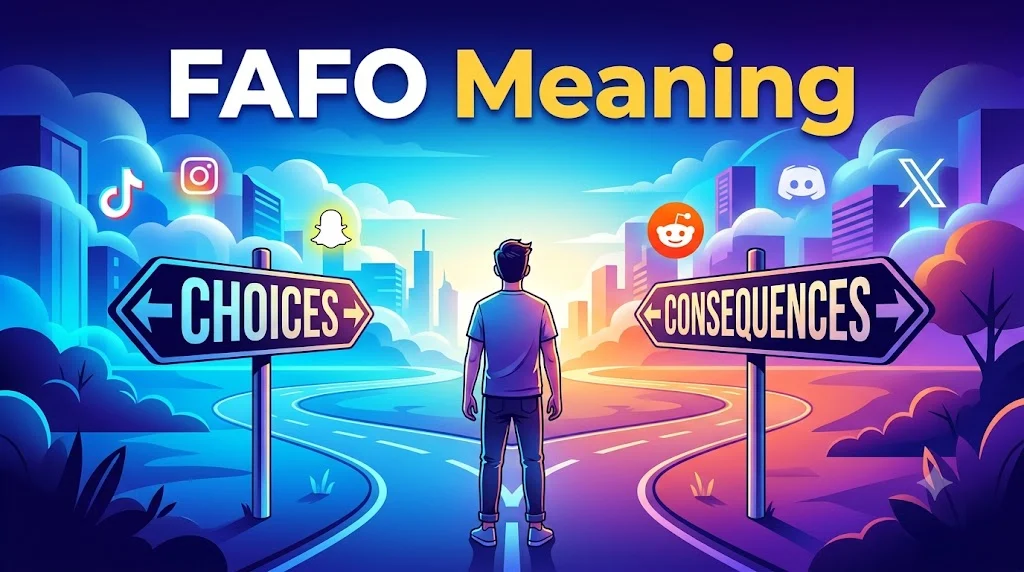
FAFO stands for “F* Around and Find Out.”** It is a popular internet slang acronym that means a person’s actions will eventually lead to consequences, especially if they take unnecessary risks, ignore warnings, or behave recklessly.
Internet slang evolves quickly, but some expressions become part of everyday language almost overnight. One of the most recognizable examples is FAFO. You’ll see it in TikTok videos, Instagram comments, X (formerly Twitter) posts, Reddit discussions, YouTube videos, and even casual conversations.
Although the phrase sounds simple, FAFO carries different meanings depending on the situation. Sometimes it’s humorous. Sometimes it’s a warning. Other times it’s used sarcastically or to celebrate someone experiencing the consequences of their own choices.
In this guide, you’ll learn the complete FAFO meaning, where the phrase originated, how people use it across different platforms, when it’s appropriate, when you should avoid it, and how to respond naturally if someone says it to you.
Quick Answer Box
| Topic | Answer |
|---|---|
| Meaning | FAFO means “F* Around and Find Out.”** |
| Type | Internet slang / Acronym |
| Tone | Bold, humorous, sarcastic, or cautionary |
| Common Platforms | TikTok, Snapchat, Instagram, X, Reddit, Discord, YouTube |
| Used For | Warning someone about consequences |
| Example | “He ignored every warning. FAFO.” |
What Does FAFO Mean?
FAFO is an acronym for:
F* Around and Find Out**
At its core, the phrase means:
If someone makes reckless, disrespectful, risky, or foolish decisions, they will eventually experience the consequences of those actions.
The expression isn’t always meant literally. Instead, people often use it as a humorous, sarcastic, or dramatic way to comment on situations where someone ignored advice and paid the price.
For example:
- Someone speeds through heavy traffic and gets a ticket.
- Someone insults another person and immediately gets called out.
- Someone ignores clear instructions and breaks something.
In each case, many internet users might simply comment:
“FAFO.”
The acronym summarizes the entire situation in just four letters.
Full Definition of FAFO
Unlike many internet abbreviations that have only one use, FAFO has several layers of meaning depending on context.
A Warning
Someone may use FAFO before another person makes a poor decision.
Example:
“Keep teasing the dog if you want… FAFO.”
Here, the speaker warns that continuing the behavior will likely have consequences.
A Reaction
Many people use FAFO after something has already happened.
Example:
“He ignored every safety rule and lost the game. FAFO.”
The phrase suggests that the outcome was predictable.
A Joke
Internet users frequently use FAFO in memes because it exaggerates everyday situations.
Example:
“I drank five energy drinks before bed.”
Comment:
“FAFO 😂”
Here, people expect funny consequences rather than serious ones.
A Life Lesson
Sometimes FAFO carries a more serious message.
It reminds people that:
- Actions matter.
- Choices have consequences.
- Ignoring advice often leads to problems.
- Personal responsibility is important.
For that reason, you’ll even hear the phrase outside internet culture.
Context and Usage
Understanding when people use FAFO matters just as much as knowing what it means.
Warning Someone
You might hear:
“Touch that electric fence and FAFO.”
The speaker isn’t encouraging danger. They’re warning someone not to do something foolish.
Commenting on Consequences
Example:
“He kept cheating during the game and got banned.”
Response:
“FAFO.”
This suggests the punishment was expected.
Friendly Banter
Among close friends, the phrase can sound playful.
Friend 1:
“I’m going to prank Jake.”
Friend 2:
“FAFO.”
The warning is humorous rather than hostile.
Online Reactions
Social media users love short comments.
Instead of writing:
“He deserved the consequences of his actions.”
They simply type:
“FAFO.”
This brevity helps explain why the phrase became viral.
Why Has FAFO Become So Popular?
Several factors explain the phrase’s popularity.
Short and Memorable
People enjoy slang that’s quick to type.
FAFO communicates an entire idea using only four letters.
Fits Internet Humor
Modern memes often revolve around instant karma.
FAFO perfectly captures that concept.
Works in Many Situations
Unlike slang tied to one trend, FAFO fits:
- Sports
- School
- Politics
- Gaming
- Relationships
- Work
- Family life
- Viral videos
Its flexibility keeps it relevant.
Emotionally Powerful
The phrase carries confidence.
It implies:
- “You were warned.”
- “You chose this.”
- “Now deal with the outcome.”
That emotional impact makes it memorable.
Real-Life Examples
Conversation Example 1: School
Student A:
“I’m not studying for tomorrow’s final.”
Student B:
“FAFO.”
Meaning:
Ignoring preparation may lead to poor grades.
Conversation Example 2: Friendship
Alex:
“I’m going to text my ex again.”
Jordan:
“FAFO.”
Meaning:
That decision may create unnecessary drama.
Conversation Example 3: Gaming
Player:
“I’m attacking the strongest boss with no armor.”
Friend:
“FAFO.”
Meaning:
Expect to lose quickly.
Conversation Example 4: Workplace
Coworker:
“I’m submitting this report without proofreading.”
Manager:
“Well… FAFO.”
Meaning:
Mistakes could create problems.
Conversation Example 5: Sports
Player:
“I’m trash-talking before the match.”
Coach:
“FAFO.”
Meaning:
Your opponent may prove you wrong.
Platform-Specific Meaning
Although the core definition remains the same, FAFO often takes on a slightly different tone depending on where it’s used online.
TikTok
On TikTok, FAFO usually appears in videos showing instant karma, unexpected consequences, or funny fails.
Creators often pair the phrase with clips where someone ignores common sense and immediately regrets it.
Typical examples include:
- Attempting risky stunts
- Ignoring safety warnings
- Pulling pranks that backfire
- Losing a challenge after overconfidence
The tone is usually humorous, dramatic, and meme-driven.
Snapchat
On Snapchat, FAFO often appears in private chats between friends.
People use it to:
- Joke about risky plans
- Warn friends playfully
- React to embarrassing moments
- Predict someone’s bad decision
Because Snapchat conversations are casual, the phrase usually feels lighthearted unless the situation is serious.
Instagram users frequently post FAFO in comment sections.
You’ll often see it beneath:
- Viral reels
- Gym videos
- Prank clips
- Relationship memes
- Celebrity news
- Sports highlights
It often replaces longer comments like:
“They definitely brought this on themselves.”
X (Formerly Twitter)
On X, FAFO tends to sound sharper.
Users employ it during discussions about:
- Current events
- Politics
- Sports
- Business decisions
- Celebrity controversies
Because posts are short, FAFO quickly communicates that someone’s actions naturally led to their outcome.
Reddit discussions usually provide more context.
Instead of using FAFO as a joke alone, Reddit users often explain why someone experienced the consequences of their actions.
For example:
“He ignored everyone’s advice for months. Classic FAFO.”
Here, the phrase summarizes the lesson after a detailed discussion.
Discord
Gaming communities use FAFO constantly.
Players may say:
- “Rush the whole team? FAFO.”
- “Open that trapped chest and FAFO.”
It has become part of competitive gaming humor.
YouTube
You’ll find FAFO throughout YouTube comments, especially under:
- Fail compilations
- Sports clips
- Police bodycam videos
- DIY mistakes
- Challenge videos
Commenters use it to describe situations where poor decisions quickly produce obvious consequences.
Alternative Meanings of FAFO
Although FAFO almost always stands for “F* Around and Find Out,”** it can occasionally appear in different contexts. However, these alternative meanings are rare and usually don’t apply in everyday conversations.
Military or Tactical Discussions
Some groups use FAFO as a humorous slogan to emphasize accountability and consequences. Even in these settings, it typically keeps the same underlying meaning: actions lead to predictable outcomes.
Business and Leadership
Occasionally, leaders or managers use a softened version of the phrase to describe learning through experience. They rarely use the explicit wording in formal settings. Instead, they may say:
- Learn by doing.
- Experience teaches the lesson.
- Actions have consequences.
The idea remains similar, but the language becomes more professional.
Pop Culture
FAFO has become a recognizable catchphrase in memes, merchandise, podcasts, and online videos. In these cases, it represents a bold attitude rather than introducing a new definition.
Bottom line: If you see FAFO online, it almost always means “F* Around and Find Out.”**
Related Terms and Similar Slang
Many internet expressions share a similar idea with FAFO. Knowing these related terms helps you understand conversations more naturally.
Instant Karma
This phrase describes someone immediately facing the consequences of their actions.
Example:
“He tried to cheat and got caught. Instant karma.”
Karma
“Karma” suggests that good or bad actions eventually return to the person who performed them.
Consequences
Unlike internet slang, “consequences” is a standard English word. FAFO simply expresses the same idea in a shorter, more dramatic way.
Reap What You Sow
This classic proverb means your actions determine your future outcomes.
Mess Around and Find Out
Some people replace the stronger language with:
Mess Around and Find Out
This version keeps the meaning while sounding more family-friendly.
Learn the Hard Way
Someone who ignores advice and later regrets it has learned the hard way.
FAFO vs. Similar Internet Slang
| Slang | Meaning | Tone |
|---|---|---|
| FAFO | Actions have consequences | Bold, sarcastic, humorous |
| YOLO | Take risks because you only live once | Adventurous |
| SMH | Showing disappointment | Frustrated |
| FR | For real | Casual |
| NGL | Not gonna lie | Honest |
| No Cap | I’m telling the truth | Confident |
| L + Ratio | Mocking someone’s failure | Humorous |
| Karma | Consequences eventually return | Neutral |
Although these phrases often appear together online, FAFO focuses specifically on cause and effect.
Emotional Meaning Behind FAFO
One reason FAFO became so popular is that it expresses emotion as much as information.
Depending on the situation, it can communicate:
Confidence
Someone believes the outcome is obvious.
Example:
“Ignore every warning if you want. FAFO.”
Humor
Friends often use it while joking.
Example:
“Eat the hottest pepper in the world.”
“FAFO 😂”
Frustration
Someone may feel another person refuses to listen.
Example:
“We’ve explained it ten times already. FAFO.”
Satisfaction
Sometimes observers feel justice has been served.
Example:
“He lied to everyone and finally got caught.”
“FAFO.”
How to Respond When Someone Says FAFO
Your response depends on the situation and your relationship with the other person.
If They’re Joking
You can keep the conversation playful.
Examples:
- “We’ll see!”
- “Challenge accepted.”
- “You might be right.”
- “I’m willing to risk it.”
If They’re Warning You
Consider taking the advice seriously.
Examples:
- “Good point.”
- “Maybe I’ll rethink that.”
- “Thanks for the warning.”
- “I didn’t think about that.”
If They’re Being Sarcastic
Stay calm.
Possible replies:
- “Fair enough.”
- “Lesson learned.”
- “You’re probably right.”
- “I’ll do better next time.”
If They’re Being Rude
Not every FAFO comment deserves a response.
Sometimes it’s better to:
- Ignore it.
- Change the subject.
- Respond politely.
- End the conversation.
Remaining respectful usually prevents unnecessary arguments.
Five More Realistic Conversation Examples
Example 1: TikTok Comments
Video: Someone ignores a “Wet Floor” sign and slips.
Comment 1: “FAFO.”
Comment 2: “The sign literally warned them.”
Example 2: Group Chat
Emma: “I’m texting my boss at 2 a.m.”
Jake: “FAFO 😂”
Emma: “Okay, maybe tomorrow.”
Example 3: Gaming
Player 1: “I’m fighting everyone alone.”
Player 2: “FAFO.”
Example 4: Sports
Fan:
“They’re celebrating before the game even starts.”
Reply:
“FAFO.”
Meaning: Don’t celebrate too early.
Example 5: Everyday Life
Friend:
“I’m skipping my car maintenance again.”
Response:
“FAFO.”
Meaning: Ignoring maintenance may cause bigger problems later.
Common Situations Where People Use FAFO
You’ll often encounter FAFO when discussing:
- Risky behavior
- Poor decisions
- Instant karma
- Funny mistakes
- Online drama
- Competitive sports
- Gaming challenges
- Viral videos
- Workplace mistakes
- School situations
- Relationship problems
- Public arguments
- Pranks
- Social media trends
Because the phrase applies to so many scenarios, it remains one of today’s most versatile internet slang terms.
Common Misinterpretations
Although FAFO is widely understood, people sometimes misunderstand its purpose.
It Doesn’t Always Mean Violence
Some assume FAFO always refers to physical confrontations.
That’s incorrect.
Many examples involve harmless situations like:
- Losing a game
- Breaking a phone
- Missing a deadline
- Forgetting homework
- Burning dinner
The “finding out” simply refers to experiencing consequences.
It Isn’t Always Insulting
Among close friends, FAFO often functions as playful teasing.
Tone matters.
A smiling emoji changes the feeling completely.
Example:
“Eat six tacos before the race. FAFO 😂”
It Doesn’t Encourage Bad Behavior
People sometimes think FAFO encourages risky actions.
Actually, the phrase usually warns against them.
Its central message is:
Think before you act.
It Isn’t Appropriate Everywhere
Although popular online, FAFO contains profanity in its full form.
Therefore, avoid using it in:
- Job interviews
- Business emails
- Academic papers
- Professional meetings
- Formal presentations
Choose more professional wording instead.
When NOT to Use FAFO
Using slang at the wrong time can create misunderstandings.
Avoid FAFO in these situations.
Professional Communication
Instead of saying:
“FAFO.”
Say:
- Actions have consequences.
- Please consider the risks.
- Think carefully before proceeding.
Customer Service
Professional language always works better.
Speaking With Young Children
A cleaner phrase like:
“Learn from your choices.”
is more appropriate.
Serious Emergencies
If someone faces a genuine emergency, avoid sarcastic comments.
Instead:
- Offer help.
- Share useful information.
- Show empathy.
Compassion matters more than internet slang.
Usage Tips
To use FAFO naturally, keep these tips in mind.
Know Your Audience
Friends may appreciate it.
Coworkers or clients may not.
Understand the Tone
FAFO can sound:
- Funny
- Serious
- Sarcastic
- Confident
- Blunt
Choose the right tone for the situation.
Use It Sparingly
Like any slang, overusing FAFO can make conversations feel repetitive.
A well-timed comment has more impact.
Consider Cultural Differences
Not everyone knows internet slang.
If someone looks confused, explain the meaning instead of assuming they understand.
Remember the Profanity
Although most people say only “FAFO,” many know the full phrase.
Keep that in mind before using it in formal or family-friendly settings.
Why FAFO Continues to Trend
FAFO remains popular because it combines several qualities people enjoy online:
- It’s short.
- It’s memorable.
- It fits memes.
- It works across platforms.
- It summarizes complex situations quickly.
- It reflects personal accountability.
- It encourages people to think before acting.
As internet culture evolves, expressions like FAFO continue to spread beyond social media into everyday conversations.
FAQs
1. What does FAFO stand for?
FAFO stands for “F* Around and Find Out.”** It’s an internet slang acronym that means someone will experience the consequences of their actions, especially after making a risky, careless, or disrespectful decision.
2. Is FAFO considered offensive?
The acronym itself is commonly used online and in text messages. However, its full phrase includes profanity. Therefore, it’s best to avoid using it in professional, academic, or family-friendly settings.
3. Where is FAFO most commonly used?
FAFO appears across many online platforms, including:
- TikTok
- Snapchat
- X (formerly Twitter)
- Discord
- YouTube
People also use it in text messages and casual conversations.
4. Does FAFO always refer to physical fights?
No. While some viral videos use FAFO in confrontational situations, the phrase generally refers to any consequences—not just physical ones.
For example, someone might:
- Ignore advice and fail a test.
- Skip car maintenance and face repairs.
- Break workplace rules and receive a warning.
- Lose a game after acting overconfident.
5. Is FAFO positive or negative?
It depends on the context.
- Positive: Used jokingly among friends.
- Neutral: Describing a predictable outcome.
- Negative: Criticizing someone’s poor choices or behavior.
The speaker’s tone usually determines how it’s interpreted.
6. Can I use FAFO at work?
Generally, no.
Because the full phrase contains profanity, it’s better to use professional alternatives such as:
7. What are some family-friendly alternatives to FAFO?
If you want the same meaning without profanity, try:
- Mess around and find out
- Actions have consequences
- Learn the hard way
- Reap what you sow
- Instant karma
These alternatives communicate a similar message in a more appropriate tone.
8. Why has FAFO become so popular?
FAFO became popular because it’s:
- Short and memorable
- Easy to type
- Perfect for memes
- Widely understood online
- Applicable to many situations
- Effective at summarizing cause and effect
Its versatility has helped it spread far beyond internet culture.
9. Can FAFO be used humorously?
Yes. In fact, many people use FAFO in a lighthearted way.
In this case, the phrase is playful rather than insulting.
10. What is the main message behind FAFO?
The central idea is simple:
Your choices have consequences.
Whether it’s used seriously, sarcastically, or humorously, FAFO reminds people that actions often lead to predictable outcomes.
Conclusion
FAFO is much more than a trending internet acronym. It has become a widely recognized expression that captures an important life lesson in just four letters: actions have consequences.
Whether you encounter it in a TikTok comment, a Snapchat message, a Reddit thread, a gaming chat, or an everyday conversation, the meaning remains remarkably consistent. Someone is either warning another person about the possible outcome of their actions or commenting that the consequences were entirely predictable.
Although FAFO often appears in humorous memes and viral videos, it’s important to remember that the phrase includes profanity in its full form. As a result, it’s best reserved for casual conversations, social media, and informal settings. In professional or formal communication, choose more neutral alternatives that express the same idea respectfully.
Understanding slang like FAFO helps you interpret online conversations more accurately and communicate with greater confidence. As digital language continues to evolve, knowing both the meaning and the appropriate context ensures you can use internet expressions naturally while avoiding misunderstandings.