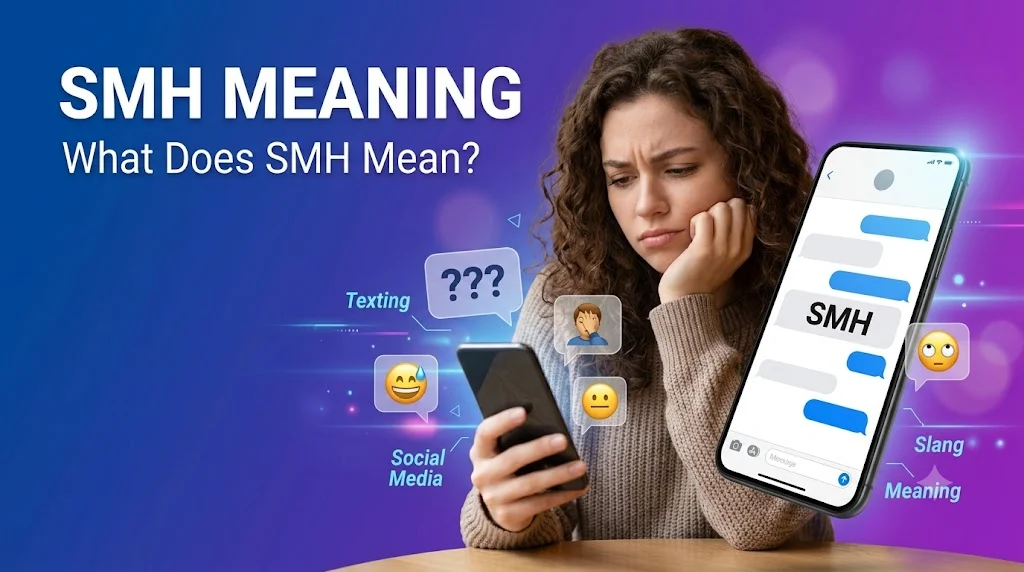
SMH stands for “Shaking My Head.” It is a popular internet slang abbreviation used to express disappointment, disbelief, frustration, embarrassment, or disapproval in response to something someone says or does.
If you’ve ever received a text that simply says “SMH”, you might have wondered what it means. This popular internet abbreviation appears everywhere from text messages and group chats to platforms like TikTok, Instagram, Snapchat, and X. Understanding the SMH meaning can help you follow online conversations and communicate more naturally in today’s digital world.
SMH stands for “Shaking My Head.” People use it to express disappointment, disbelief, frustration, or mild embarrassment in response to something surprising, foolish, or annoying. Rather than typing a full sentence, users often write “SMH” as a quick way to show their reaction. It’s commonly used in casual conversations and social media posts.
In this guide, you’ll learn the complete SMH meaning, where the abbreviation came from, when to use it, and when to avoid it. We’ll also cover real-life examples, common mistakes, similar slang terms, and answers to frequently asked questions so you can confidently understand and use SMH in everyday online communication.
Quick Answer Box
| Field | Detail |
|---|---|
| Meaning | Shaking My Head |
| Context | Disappointment, disbelief, frustration |
| Platforms | Text, Twitter, Instagram, TikTok, Snapchat |
| Example | “He forgot her birthday again. SMH.” |
| Tone | Negative, sarcastic, sometimes playful |
What Does SMH Mean?
Full Definition
SMH means “Shaking My Head.” It is an internet abbreviation that people use to react to something disappointing, embarrassing, or just plain. When someone types SMH, they are virtually shaking their head in disbelief or frustration exactly like you would do in real life when you cannot believe what just happened.
The term first appeared in online chat rooms and forums in the early 2000s. However, it exploded in popularity after social media platforms took over daily communication. Today, millions of people use SMH every single day across the globe.
Why People Use SMH
People use SMH because some situations feel too ridiculous for a full sentence. Furthermore, it is fast, expressive, and universally understood. When someone does something disappointing, or shocking, SMH captures that reaction instantly. It saves time while still delivering a powerful emotional punch.
Context and Usage of SMH
When to Use SMH
SMH works best in informal, casual conversations. You should use it when:
- Someone does something incredibly foolish
- A situation turns out worse than expected
- You witness behavior that leaves you speechless
- You want to express mild frustration without being too aggressive
- You are reacting to news that is embarrassing or sad
For example, if your friend shows up two hours late without calling, you might reply with a simple “SMH.” That one word communicates everything your frustration, your disbelief, and your judgment all at once.
Tone of SMH
The tone of SMH depends heavily on context. Moreover, it can shift from serious to playful depending on who is using it and how. Here are the three main tones:
- Frustrated SMH | Used when something genuinely upsets you
- Sarcastic SMH | Used when something is so predictable it is almost funny
- Playful SMH | Used with friends when teasing or joking around
Real-Life Conversation Examples
Example 1 | Forgetting Something Important
Jordan: Bro I left my wallet at home again.
Alex: SMH. That’s the third time this week.
Example 2 | Disappointing News
Maya: They cancelled the concert last minute.
Chris: SMH. I already bought the tickets.
Example 3 | Reacting to Drama
Tia: Did you see what happened on the show last night?
Sam: Yeah. SMH. That character ruined everything.
Example 4 | Playful Teasing
Leo: I put the milk in the cabinet instead of the fridge.
Jess: SMH you need help honestly 😂
Example 5 | Reacting to the News
Dana: Gas prices went up again.
Ryan: SMH. Every single week.
Platform-Specific Meaning of SMH
SMH on Twitter and X
On Twitter, SMH appears constantly in reaction tweets. Users drop it in replies when a celebrity, politician, or brand does something questionable. It is short, punchy, and fits perfectly within character limits. Therefore, it became a go-to reaction word on the platform.
SMH on Instagram
On Instagram, SMH shows up in comments under posts that spark controversy or disbelief. For example, if someone posts a risky stunt or a controversial opinion, the comment section fills up with SMH responses almost immediately.
SMH on Snapchat
On Snapchat, SMH appears in quick snap replies and chat messages. Because Snapchat communication is fast and casual, SMH fits perfectly into the platform’s vibe. It lets users react quickly without typing a long response.
SMH on TikTok
TikTok users use SMH in video comments, duets, and stitches. When a TikTok video shows something cringe-worthy or unbelievable, SMH floods the comment section. Additionally, creators sometimes use it in their own captions to set a sarcastic or frustrated tone before the video even starts.
SMH in Text Messages
In everyday texting, SMH is one of the most common abbreviations. People send it to friends and family when reacting to situations that feel too ridiculous to explain fully. It works perfectly in one-on-one conversations as a quick emotional shorthand.
Alternative Meanings of SMH
Other Interpretations
While “Shaking My Head” is by far the most common meaning, SMH does carry a few alternative interpretations in specific contexts:
- “So Much Hate” | Sometimes used in online arguments or social commentary
- “Scratching My Head” | Used when someone is confused rather than frustrated
- Sydney Morning Herald | A major Australian newspaper, though this usage only appears in news and media contexts
However, in everyday digital communication, SMH almost always means “Shaking My Head.” You should not overthink it in casual conversations.
Related Terms and NLP Variations
Words and Phrases Similar to SMH
Understanding SMH becomes easier when you also know the related terms people use alongside it. Here are the most common ones:
- Facepalm | A physical or emoji gesture expressing the same disappointment
- IKR (I Know Right) | Used to agree with something frustrating or unbelievable
- Bruh | A casual expression of disbelief or exasperation
- Oof | A reaction to something painful, awkward, or disappointing
- Lowkey embarrassing | A softer, more Gen Z way of expressing the same feeling
- No cap | Used to emphasize that a frustrating situation is real and not exaggerated
- FR (For Real) | Often paired with SMH to add emphasis
How These Words Work Together
People often combine these terms for extra effect. For example, “SMH fr that was embarrassing” uses both SMH and FR together. Furthermore, combining them creates a stronger emotional reaction without needing more words.
How to Respond When Someone Says SMH
Responding to a Frustrated SMH
If someone sends you SMH in a frustrated tone, acknowledge their feelings first. For example:
Friend: SMH I can’t believe they did that.
You: Right? That was completely out of line.
Responding to a Playful SMH
If the SMH feels lighthearted or teasing, match their energy:
Friend: SMH you burnt the toast again 😂
You: In my defense, I was distracted 😭
When SMH Is Directed at You
If someone sends SMH as a reaction to something you did, read the tone carefully. If it feels serious, apologize or explain. If it feels playful, laugh it off and respond with humor.
Common Misinterpretations of SMH
Misreading the Tone
One of the biggest misinterpretations of SMH is assuming it is always serious. In reality, context changes everything. Therefore, you should always read the surrounding conversation before reacting.
Confusing SMH With Anger
SMH expresses disappointment or disbelief, not necessarily anger. Many people mistake it for an aggressive response. However, it is usually a mild, non-confrontational reaction. Unless the full message sounds aggressive, SMH alone is rarely an attack.
Using SMH in Formal Settings
Some people mistakenly use SMH in professional emails or work messages. This is a mistake. SMH belongs in casual, informal communication only. Consequently, using it in a formal setting can come across as unprofessional or immature.
When NOT to Use SMH
Avoid SMH in These Situations
- Professional emails Always use formal language in work communication
- Serious emotional conversations If someone is going through a hard time, SMH can feel dismissive
- Talking to older adults unfamiliar with internet slang It may cause confusion
- Academic writing Internet abbreviations have no place in essays or reports
- Customer service interactions It undermines professionalism
Why It Matters
Using SMH in the wrong context can come across as rude, dismissive, or confusing. Therefore, always consider your audience before sending it.
Usage Tips for SMH
Tips for Using SMH Naturally
- Pair it with a short explanation for clarity “SMH, he really forgot again”
- Use it at the beginning or end of a sentence for maximum effect
- Combine it with emojis to soften or emphasize the tone
- Do not overuse it too much SMH in one conversation loses its impact
- Read the room only use SMH with people who understand internet slang
FAQs
What does SMH mean in texting?
SMH means “Shaking My Head” in texting. People use it to express disappointment, frustration, or disbelief in a quick and casual way.
Is SMH rude?
SMH is not inherently rude. However, the tone depends on context. In some situations, it can feel dismissive or passive-aggressive, so use it carefully.
Can SMH mean something other than Shaking My Head?
Yes, in rare cases SMH can mean “So Much Hate” or “Scratching My Head.” However, “Shaking My Head” remains the dominant and most widely understood meaning.
Where did SMH come from?
SMH originated in early internet culture, specifically in chat rooms and forums in the early 2000s. It gained massive popularity with the rise of social media.
Is SMH used worldwide?
Yes, SMH is used globally wherever English internet culture has spread. You will find it on platforms across North America, the UK, Australia, and beyond.
Can you use SMH sarcastically?
Absolutely. In fact, sarcastic SMH is extremely common. For example, “Oh wow, he was late again. SMH 🙄” uses SMH with a sarcastic tone.
Is SMH formal or informal?
SMH is strictly informal. Moreover, you should never use it in professional, academic, or formal writing.
How do you use SMH in a sentence?
You can use SMH at the start, middle, or end of a sentence. For example: “SMH, I cannot believe that happened” or “He did it again. SMH.”
What emoji goes well with SMH?
Common emojis paired with SMH include 🤦, 😤, 🙄, 😒, and 😂 depending on whether the tone is frustrated, sarcastic, or playful.
Is SMH still popular in 2025?
Yes, SMH remains one of the most widely used internet abbreviations. Furthermore, it continues to appear daily across social media, texting, and online communities.
Conclusion
SMH Shaking My Head is one of the most expressive and widely recognized abbreviations in digital communication. It captures frustration, disbelief, and disappointment in just three letters. Whether you see it on Twitter, TikTok, Instagram, or in a text message, the meaning is almost always the same someone just witnessed something they cannot believe.
Understanding SMH helps you communicate more naturally online. Moreover, knowing when and how to use it ensures you never send the wrong signal in a conversation. Use it in casual settings, pair it with context when needed, and always consider your audience.
Now that you know exactly what SMH means, how it works, and where it comes from, you are fully equipped to use it confidently in your digital conversations.
Discover More Related Articles: