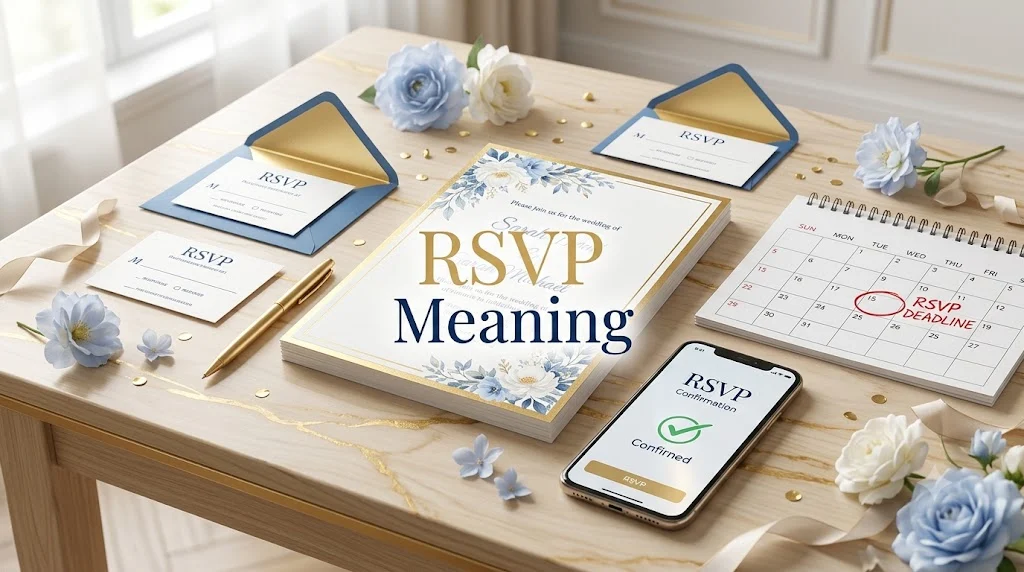
RSVP is a request asking invited guests to let the host know whether they will attend an event. It helps the organizer plan seating, food, and other arrangements accurately.
Have you ever received an invitation that says “RSVP by June 15” and wondered exactly what it means? You’re not alone. Although RSVP appears on millions of invitations every year, many people aren’t sure what they’re supposed to do or why responding matters so much.
Whether you’re attending a wedding, hosting a birthday party, organizing a corporate event, or responding to an online invitation, understanding the RSVP meaning helps you communicate politely and avoid common etiquette mistakes.
In this guide, you’ll learn:
- The exact RSVP meaning
- Where the term comes from
- Why RSVP is important
- How to RSVP correctly
- When to use RSVP
- Examples of RSVP in conversations
- Platform-specific usage
- Common misunderstandings
- Tips for hosts and guests
- Frequently asked questions
By the end, you’ll know exactly how to use RSVP confidently in any situation.
Quick Answer Box
| Topic | Answer |
|---|---|
| Meaning | Please respond |
| Full Form | Répondez s’il vous plaît |
| Language | French |
| English Translation | Please respond |
| Purpose | Confirm attendance |
| Used For | Invitations and events |
| Common Platforms | Wedding invitations, Email, Facebook Events, Evite, Paperless Post, Text Messages |
| Example | “Please RSVP by July 20.” |
| Tone | Polite and formal |
What Does RSVP Mean?
RSVP is an abbreviation of the French phrase:
Répondez s’il vous plaît
In English, it means:
“Please respond.”
The phrase politely asks invited guests to let the host know whether they will attend an event.
Importantly, RSVP does not automatically mean “yes.” Instead, it requests a response—either accepting or declining the invitation.
For example:
Invitation
You’re invited to Emma and Jake’s wedding.
Please RSVP by August 10.
The couple simply wants to know whether you’ll attend.
Full Definition of RSVP
RSVP is an invitation request asking guests to confirm whether they plan to attend an event before a specified deadline.
The response usually falls into one of three categories:
- Yes, I will attend.
- No, I cannot attend.
- Sometimes, additional details such as meal preferences or guest count are requested.
Hosts use RSVP responses to make important planning decisions, including:
- Ordering food
- Arranging seating
- Preparing guest favors
- Booking venue space
- Finalizing event schedules
- Managing budgets
Therefore, responding promptly helps the host organize the event more efficiently.
Where Does RSVP Come From?
Although RSVP appears on English invitations worldwide, it actually comes from French.
The original phrase is:
Répondez s’il vous plaît
Word-by-word translation:
- Répondez = Respond
- S’il = If it
- Vous = You
- Plaît = Pleases
Natural English translation:
Please respond.
The expression became popular among European aristocracy during the 18th and 19th centuries. Later, English-speaking countries adopted it because it sounded elegant and conveyed polite etiquette.
Today, RSVP remains a standard part of invitations across the United States and many other countries.
Why Is RSVP Important?
Many people think RSVP is just a formality. However, it plays a critical role in event planning.
When guests respond, hosts can:
Plan Food Accurately
Every guest affects catering costs. Therefore, knowing the final attendance prevents waste and unexpected expenses.
Arrange Seating
Wedding receptions, conferences, and banquets require seating charts. RSVP responses help hosts assign seats efficiently.
Prepare Event Materials
Business seminars, workshops, and training sessions often need printed materials, name tags, or welcome packages.
Manage Budgets
Most event expenses depend on guest count. Accurate RSVPs help hosts stay within budget.
Avoid Last-Minute Confusion
Knowing who will attend reduces stress and improves the overall event experience.
Context and Usage
People use RSVP in many everyday situations. While weddings are the most common example, RSVP applies to almost any planned event.
Weddings
Wedding invitations almost always include an RSVP deadline.
Example:
Please RSVP by May 30.
Birthday Parties
Parents frequently request RSVPs for children’s birthday parties so they can prepare food and party favors.
Example:
Please RSVP before Friday.
Baby Showers
Expecting parents use RSVP cards to estimate attendance and prepare gifts, food, and seating.
Graduation Parties
Graduation celebrations often require RSVPs, especially when catering is involved.
Corporate Events
Businesses ask employees or clients to RSVP for meetings, conferences, networking events, and holiday parties.
Charity Events
Fundraisers and nonprofit organizations use RSVPs to estimate attendance and plan logistics.
Community Gatherings
Schools, churches, and local organizations also request RSVPs for special events and celebrations.
RSVP Etiquette
Understanding RSVP etiquette helps both guests and hosts.
For Guests
Always respond before the deadline.
If you know you cannot attend, politely decline.
If your plans change after responding, notify the host immediately.
Avoid bringing extra guests unless the invitation specifically allows it.
Respond even if you decline.
Many people mistakenly believe they only need to answer if they’re attending. However, hosts also need to know who won’t be there.
For Hosts
Clearly include:
- RSVP deadline
- Contact information
- Phone number
- Email address
- RSVP website (if applicable)
Additionally, make responding easy. Guests are more likely to reply when the process is simple.
Different Ways to RSVP
Modern invitations offer several response methods.
Email RSVP
Many business events request replies through email.
Example:
Please RSVP to events@example.com by July 10.
Phone RSVP
Some family gatherings still use phone confirmations.
Example:
Call Sarah before Monday.
Text Message RSVP
Texting has become increasingly popular for casual events.
Example:
Text YES or NO by Friday.
Online RSVP
Digital invitations often include a button that says:
- Accept
- Decline
- Maybe
This makes responding fast and convenient.
How to RSVP Politely
Accepting an invitation:
Thank you for inviting me. I’d be delighted to attend.
Declining respectfully:
Thank you for the invitation. Unfortunately, I won’t be able to attend.
Changing your response:
I’m sorry for the change in plans. Unfortunately, I can no longer attend.
Always remain polite and respond as soon as possible.
Real-Life Examples of RSVP
Learning through examples makes RSVP much easier to understand. Below are realistic conversations that show how people use RSVP in everyday situations.
Conversation Example 1: Wedding Invitation
Emma: Did you receive our wedding invitation?
Sophia: Yes, I did. Thank you so much!
Emma: Wonderful! Please RSVP by August 15.
Sophia: Absolutely. My husband and I will be there. We’re excited to celebrate with you.
Meaning: Sophia confirmed that she will attend before the RSVP deadline.
Conversation Example 2: Birthday Party
Alex: I’m having a birthday party this Saturday.
Jordan: Sounds fun!
Alex: Can you RSVP by Wednesday? I need to order pizza.
Jordan: Of course! Count me in.
Meaning: Alex needs an accurate guest count to plan food.
Conversation Example 3: Business Event
Manager: We’re hosting a networking dinner next week.
Employee: Great! What do I need to do?
Manager: Please RSVP by Friday so we can reserve enough seats.
Employee: I’ll attend. Thanks for letting me know.
Meaning: RSVP helps organizers make business arrangements.
Conversation Example 4: Graduation Party
Lisa: My graduation party is on June 20.
Emily: Congratulations!
Lisa: Thank you! Please RSVP by June 10.
Emily: I’ll definitely be there.
Meaning: Lisa wants to know how many guests will attend.
Conversation Example 5: Family Dinner
Mom: We’re having a family dinner on Sunday.
David: Nice!
Mom: Please RSVP tonight because I’m buying groceries tomorrow.
David: I’ll be there with the kids.
Meaning: RSVP helps plan meals and seating.
Platform-Specific Meaning of RSVP
Although RSVP always means “Please respond,” the way people use it varies across different platforms and situations.
RSVP in Email
Professional emails often include RSVP requests for meetings, conferences, workshops, or company events.
Example:
Please RSVP by October 5.
This tells recipients to confirm whether they will attend.
Common business responses:
- I will attend.
- Thank you. I’ll be there.
- Unfortunately, I cannot attend.
RSVP in Text Messages
Text messages usually keep RSVP requests short and simple.
Example:
BBQ this Saturday! RSVP by Thursday.
Possible replies:
- Yes!
- Count me in.
- Sorry, I can’t make it.
- Thanks for inviting me!
Because texting is informal, short replies are perfectly acceptable.
RSVP on WhatsApp
Many families, schools, and community groups organize events through WhatsApp.
Example:
Please RSVP in the group by Friday.
People may reply:
- 👍 I’ll come.
- Yes, see you there.
- Sorry, I’ll miss it.
Some organizers also create polls to make responses easier.
RSVP on Facebook Events
Facebook includes built-in RSVP options.
Instead of typing a response, users simply choose:
- Going
- Interested
- Not Going
This digital version of RSVP helps event organizers estimate attendance quickly.
RSVP on Digital Invitation Platforms
Websites like Evite and Paperless Post simplify the RSVP process.
Guests usually click one of these options:
- Accept
- Decline
- Maybe
Some invitations also ask for:
- Meal choice
- Number of guests
- Dietary restrictions
- Personal message
RSVP for Weddings
Wedding RSVPs often include additional information because weddings require detailed planning.
Guests may need to provide:
- Attendance confirmation
- Meal preference
- Guest names
- Song requests
- Dietary restrictions
Example:
✔ Chicken
✔ Vegetarian
This information helps the couple coordinate with caterers and venues.
RSVP for Corporate Events
Companies use RSVP requests for:
- Conferences
- Holiday parties
- Team lunches
- Networking events
- Training sessions
- Award ceremonies
Professional responses should remain courteous.
Example:
Thank you for the invitation. I look forward to attending.
RSVP for School Events
Schools often request RSVPs for:
- Parent-teacher nights
- Graduation ceremonies
- School plays
- Volunteer events
- Fundraisers
Parents usually respond through:
- Online forms
- Paper slips
- School apps
Alternative Meanings of RSVP
In everyday English, RSVP almost always refers to invitations. However, some organizations and projects use RSVP as an acronym with different meanings.
Examples include:
- Regional Smoking Vehicle Program
- Resource Sharing Volunteer Program
- Remote Service Validation Process
- Research Study Volunteer Program
These meanings depend entirely on the industry or organization.
For the average person, RSVP simply means “Please respond.”
RSVP vs. Regrets Only
These phrases often appear on invitations, but they are not the same.
| RSVP | Regrets Only |
|---|---|
| Everyone should respond | Only guests who cannot attend respond |
| Accept or decline | Decline only |
| Most common option | Less common |
| Used for weddings, parties, business events | Often used for casual receptions |
For example:
RSVP by July 10
Everyone replies.
Regrets Only
Only people who cannot attend respond.
Related Terms and NLP Variations
People don’t always search using the exact keyword “RSVP meaning.” Search engines recognize many related phrases that express the same intent.
Common Variations
- RSVP full form
- RSVP definition
- What does RSVP stand for?
- What is RSVP?
- RSVP explained
- RSVP abbreviation
- RSVP meaning on invitation
- RSVP meaning in English
- RSVP meaning for weddings
- RSVP response meaning
- RSVP deadline
- RSVP etiquette
- How do you RSVP?
- RSVP reply examples
- RSVP confirmation
These variations all relate to understanding how RSVP works.
Common RSVP Phrases
Here are some expressions you’ll frequently see on invitations.
Please RSVP
The most common wording.
Example:
Please RSVP by June 1.
Kindly RSVP
Slightly more formal.
Example:
Kindly RSVP before September 15.
RSVP Required
This emphasizes that a response is expected.
Example:
RSVP Required by August 20.
RSVP Today
Often used for events with limited seating.
Example:
RSVP today to reserve your seat.
RSVP by [Date]
The invitation specifies a response deadline.
Example:
RSVP by April 30.
Accepts with Pleasure
A formal acceptance phrase sometimes printed on RSVP cards.
Example:
Accepts with pleasure.
Declines with Regret
A polite way to decline an invitation.
Example:
Declines with regret.
Why Some People Forget to RSVP
Even polite people sometimes forget to respond.
Common reasons include:
- They overlook the invitation.
- They intend to reply later.
- They are waiting to confirm their schedule.
- They assume their attendance is obvious.
- They don’t realize a response is required.
However, delaying an RSVP creates extra work for the host. Therefore, it’s always best to reply as soon as you know your plans.
Modern RSVP Trends
Technology has changed how people RSVP, but the purpose remains the same.
Today, hosts often use:
- Online invitation websites
- QR code RSVPs
- Google Forms
- Event management platforms
- Social media event pages
- Mobile event apps
These tools make responding faster while helping organizers manage guest lists more efficiently.
RSVP Tips for Guests
- Respond as soon as possible.
- Respect the RSVP deadline.
- Don’t assume the host knows you’re coming.
- Be honest if you cannot attend.
- Inform the host if your plans change.
- Avoid bringing uninvited guests.
- Read the invitation carefully before replying.
- Include any requested information, such as meal preferences or dietary restrictions.
Following these simple tips shows respect for the host and helps the event run smoothly.
How to Respond to an RSVP Request
Knowing the RSVP meaning is only half the story. You should also know how to respond politely and on time. Whether you’re accepting or declining an invitation, a thoughtful reply shows respect for the host’s planning efforts.
Accepting an Invitation
If you plan to attend, keep your response clear, friendly, and prompt.
Formal Example
Thank you for the invitation. I’m delighted to attend and look forward to celebrating with you.
Semi-Formal Example
Thanks so much for inviting me! I’ll be there and can’t wait to see everyone.
Casual Example
Count me in! Looking forward to it.
Declining an Invitation
Sometimes you can’t attend. In that case, reply politely and avoid leaving the host guessing.
Formal Example
Thank you for the invitation. Unfortunately, I won’t be able to attend. I hope you have a wonderful event.
Friendly Example
I’m sorry I have a scheduling conflict. Thanks for thinking of me, and I hope you all have an amazing time!
Short Example
Thanks for inviting me. Unfortunately, I can’t make it.
If Your Plans Change
Life happens, and plans sometimes change after you’ve already responded. If that happens, let the host know as soon as possible.
Example:
I’m very sorry, but something unexpected came up and I can no longer attend. Thank you for understanding.
The sooner you inform the host, the easier it is for them to adjust seating, catering, or other arrangements.
Common RSVP Reply Templates
Here are ready-to-use responses for different occasions.
Wedding RSVP
Accept
Thank you for your invitation. We are delighted to attend your wedding and celebrate your special day with you.
Decline
Thank you for inviting us. Unfortunately, we won’t be able to attend, but we wish you both a lifetime of happiness.
Birthday Party RSVP
Accept
Happy to come! Thanks for inviting me.
Decline
Sorry, I already have plans that day. Have a fantastic birthday!
Business Event RSVP
Accept
Thank you for the invitation. I confirm my attendance and look forward to the event.
Decline
Thank you for the invitation. Unfortunately, I have another commitment and won’t be able to attend.
Dinner Invitation RSVP
Accept
We’d love to join you for dinner. Thank you!
Decline
Thanks so much for inviting us. Unfortunately, we won’t be able to make it.
Common Misinterpretations of RSVP
Although RSVP is a simple request, many people misunderstand what it means. Let’s clear up a few common myths.
Misunderstanding #1: RSVP Means “Yes”
This is incorrect.
RSVP means “Please respond,” not “I’m coming.”
You should always reply with either:
- Yes
- No
Both responses are equally important.
Misunderstanding #2: Only Respond If You’re Attending
Many people think silence means they aren’t coming.
However, hosts shouldn’t have to guess. Always respond, even if you can’t attend.
Misunderstanding #3: The Deadline Doesn’t Matter
Some guests reply days or even weeks after the RSVP deadline.
Unfortunately, this can create problems because the host may have already:
- Ordered food
- Printed seating charts
- Paid the venue
- Confirmed guest numbers
Therefore, respect the deadline whenever possible.
Misunderstanding #4: You Can Bring Extra Guests
Don’t assume you can bring a friend, spouse, or child unless the invitation specifically says so.
For example:
✔ “John Smith and Guest”
means you may bring one guest.
However,
✔ “John Smith”
means the invitation is only for you.
Misunderstanding #5: A “Maybe” Counts as an RSVP
Unless the invitation specifically includes a “Maybe” option, the host needs a definite answer.
If you’re unsure, explain your situation and give an estimated decision date.
When NOT to Use RSVP
Although RSVP is widely used, it doesn’t fit every situation.
Avoid using RSVP for:
Casual Hangouts
Example:
Want to grab coffee tomorrow?
An RSVP isn’t necessary because the invitation is informal.
Last-Minute Plans
Example:
Let’s meet in 20 minutes.
A simple confirmation is enough.
Everyday Conversations
You don’t need RSVP for ordinary social plans like:
- Going shopping
- Meeting for lunch
- Visiting a friend
Ongoing Group Chats
If your family group regularly plans dinners without formal invitations, asking everyone to “RSVP” may sound overly formal.
Instead, you can simply ask:
Who’s coming?
Best Practices for Hosts
If you’re organizing an event, these tips will help you receive more RSVP responses.
Set a Clear Deadline
Instead of writing:
RSVP soon
Write:
Please RSVP by July 20.
Specific dates encourage faster responses.
Make Responding Easy
Offer one or more convenient methods:
- Phone
- Text
- RSVP website
- QR code
- Online form
The easier the process, the more likely guests will reply.
Send Friendly Reminders
If the deadline is approaching, send a polite reminder.
Example:
Just a friendly reminder to RSVP by Friday. We’d love to know if you’ll be joining us!
Keep Your Guest List Organized
Track responses in a spreadsheet or event management app.
Include:
- Guest name
- Response
- Meal choice
- Guest count
- Special requests
Best Practices for Guests
Good RSVP etiquette helps every event run smoothly.
- Reply within a few days whenever possible.
- Don’t wait until the deadline if you already know your plans.
- Read the invitation carefully.
- Respect guest limits.
- Arrive on time if you accepted.
- Inform the host immediately if your plans change.
Small gestures like these leave a positive impression.
FAQs
1. What does RSVP stand for?
RSVP stands for the French phrase “Répondez s’il vous plaît,” which translates to “Please respond.”
2. Does RSVP mean yes or no?
Neither. It simply asks you to respond by accepting or declining the invitation.
3. Is RSVP required?
If an invitation includes RSVP, you should respond before the deadline, even if you cannot attend.
4. What happens if I don’t RSVP?
The host may not know whether to prepare food, seating, or accommodations for you. This can make event planning difficult.
5. How do I RSVP politely?
Thank the host, clearly state whether you’ll attend, and send your response before the deadline.
6. Can I change my RSVP later?
Yes. However, notify the host as soon as your plans change.
7. Is RSVP only used for weddings?
No. People use RSVP for birthdays, graduations, business meetings, conferences, charity events, dinners, school functions, and many other occasions.
8. What’s the difference between RSVP and “Regrets Only”?
With RSVP, everyone should reply. With “Regrets Only,” only guests who cannot attend need to respond.
9. Can I RSVP by text message?
Yes. Many modern invitations accept responses through text messages, email, online forms, or event platforms.
10. Why is RSVP important?
RSVP helps hosts plan food, seating, budgets, staffing, venue space, and event logistics accurately, making the experience better for everyone.
Conclusion
Understanding the RSVP meaning is about more than learning a French phrase. It’s about practicing good communication and showing consideration for the people hosting an event.
Whether you’re attending a wedding, birthday celebration, graduation, corporate meeting, or family gathering, responding to an RSVP promptly helps the host plan with confidence. Moreover, it demonstrates respect for their time, budget, and effort.
Discover More Related Articles:
- TLDR Meaning | Emails & Online Discussions In 2026
- Fascist Meaning | Historical Background & Modern Usage In 2026