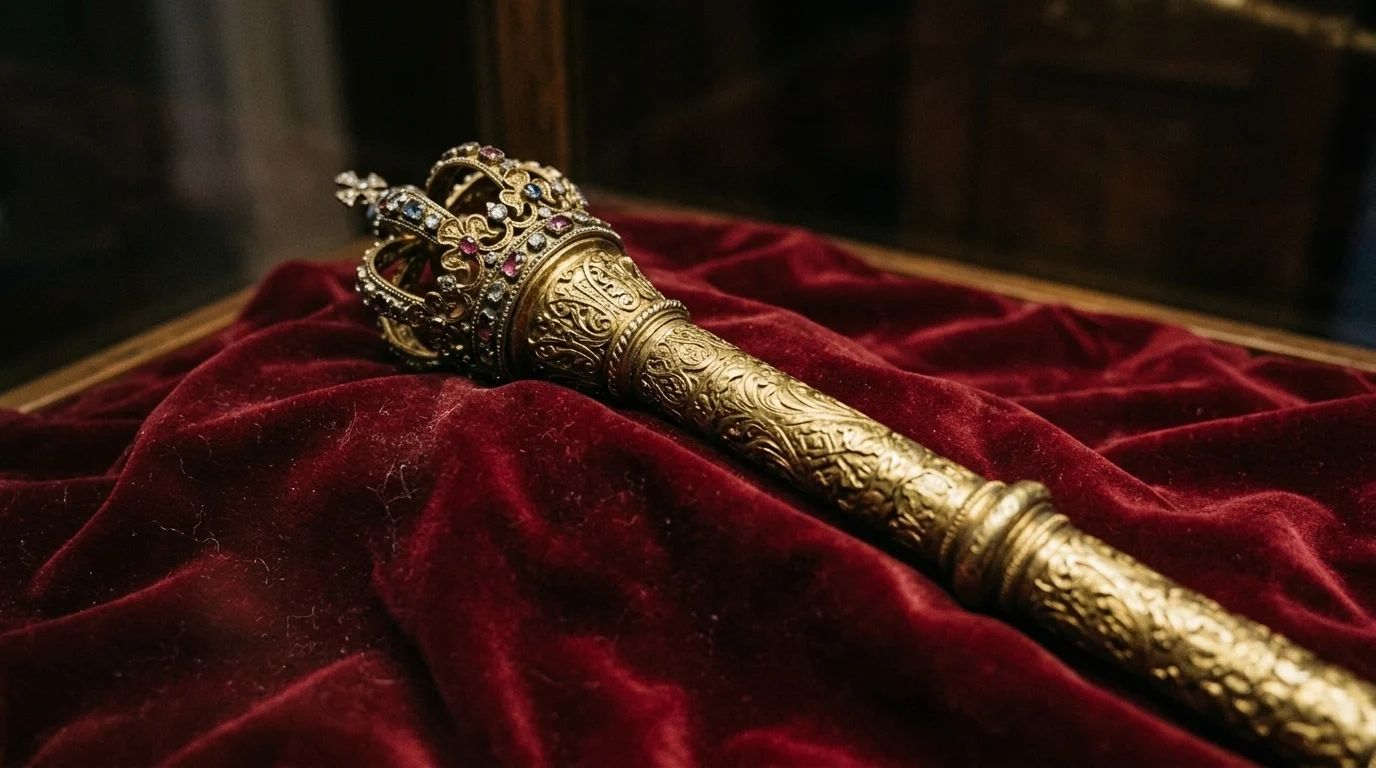
Quick Answer: A scepter is an ornamental staff or rod held by a monarch as a symbol of royal authority and power. The word comes from the Greek skeptron, meaning “staff to lean on,” and appears throughout history as a sign of kingship, divine appointment, and sovereign rule.
A scepter is more than a decorative object. It is a physical emblem of the right to rule, carried by kings, queens, and emperors across cultures and centuries. From ancient Mesopotamia to modern coronations, the scepter has served as a tangible representation of authority that words alone cannot convey.
The word itself carries the weight of that history. Understanding scepter means understanding how societies have visualized power, legitimacy, and the relationship between rulers and the divine. Whether encountered in a museum, a biblical passage, or a royal ceremony, the scepter points toward something fundamental about how humans organize authority.
What Does Scepter Mean?
At its core, scepter refers to a ceremonial staff held by a monarch as a symbol of authority . The word can also function abstractly to mean royal or imperial power itself—as in the phrase “to assume the scepter,” meaning to take up rule .
The spelling varies by region. Scepter is the standard American English form, while sceptre is the British spelling . Both refer to the same object and carry identical meanings. The pronunciation is the same: /ˈsɛp.tər/ (SEP-tur).
Word Origin
Scepter entered English around 1300 from the Old French ceptre, which derived from the Latin sceptrum, itself borrowed from the Greek skēptron . The Greek word meant “staff to lean on,” from the verb skeptein, “to support oneself” . This origin reveals an important truth: the scepter began not as a weapon or a crown, but as something to lean on—a walking stick that became a symbol of the one who could support others.
The Historical Development of the Scepter
The scepter’s history stretches back to the earliest recorded civilizations. Its form and meaning evolved across cultures, yet the core association with authority remained constant.
Ancient Origins
The prototype of the scepter combined two ideas: the staff that marked an important person (an elder or chief) and the striking weapon such as a mace or axe . A Mesopotamia, gods and rulers were depicted holding staff-scepters. A Egypt, the was-scepter served as one of the pharaoh’s regalia .
In ancient Greece, scepters were carried by kings, priests, judges, ambassadors, heralds, and orators . The scepter was also an attribute of many gods, especially Zeus as king of the gods. Later, the scepter entered Zeus’s iconography as a simple staff, reflecting its dual nature as both a symbol of rule and a practical object .
Roman and Medieval Europe
The Romans adopted the scepter as a symbol of imperial power. Ivory scepters topped with eagle figures were carried by triumphators, and emperors were depicted with them in statues and coins . In the medieval period, the scepter became a standard regalia of Byzantine and European monarchs, often paired with the orb .
In Russia, the scepter first appears in connection with the coronation of Feodor Ivanovich in 1584 and became firmly established in the coronation ritual with Michael Feodorovich in 1613 . The Kremlin’s Armory Chamber preserves several historical scepters from this period.
Scepter Across Languages and Cultures
The word has equivalents in many languages, nearly all derived from the same Greek root.
| Language | Form | Notes |
|---|---|---|
| Greek | σκῆπτρον (skēptron) | Original root, meaning “staff to lean on” |
| Latin | sceptrum | Borrowed from Greek |
| Old French | ceptre | Source of the English word |
| German | Zepter | Standard German form |
| Danish | scepter | Standard Danish form |
| Spanish | cetro | Standard Spanish form |
| Italian | scettro | Standard Italian form |
| Russian | скипетр (skipetr) | Standard Russian form |
The Danish Royal Scepter
Denmark’s royal scepter offers a concrete example of the object’s enduring role. The Danish kings’ scepter was made for the coronation of Frederik III in 1648. It consists of a long gold tube topped with a lily beneath a crown, the lily being an ancient Christian symbol of grace . The scepter was last carried at the anointing of Christian VIII in 1840. Today, the regalia are used only at the monarch’s death, when the scepter and other regalia are placed before the coffin .
Scepter in the Bible
The scepter appears frequently in biblical texts as a symbol of authority, kingship, and divine appointment . Its significance in Scripture extends from the patriarchal narratives to the New Testament’s depiction of Christ’s eternal reign.
Old Testament References
The concept is introduced in Genesis 49:10, where Jacob blesses his son Judah: “The scepter will not depart from Judah, nor the ruler’s staff from between his feet, until Shiloh comes” . This prophecy established the tribe of Judah as the royal lineage, ultimately leading to the Davidic dynasty and the messianic expectation.
In Numbers 24:17, Balaam’s oracle declares: “A star will come out of Jacob, and a scepter will rise out of Israel” . This passage is traditionally interpreted as a messianic prophecy foretelling a future ruler from Israel.
The Book of Esther provides a narrative example. When Queen Esther approaches King Xerxes unsummoned, her life is spared when the king extends his golden scepter to her, signifying favor and granting permission to speak (Esther 5:2) . Here, the scepter represents the royal authority to grant life or death.
New Testament Fulfillment
The Epistle to the Hebrews applies scepter imagery to Christ: “Your throne, O God, endures forever and ever, and justice is the scepter of Your kingdom” (Hebrews 1:8) . This quotation of Psalm 45:6 portrays Christ’s rule as characterized by righteousness. The single New Testament reference to scepter is a variation of this psalm .
Symbolic Significance in Scripture
Throughout the Bible, the scepter serves as a tangible representation of legitimate authority and governance . It signifies the right to rule, the exercise of justice, and the establishment of order. The scepter’s association with Judah and the Davidic line gives it messianic weight, pointing toward the ultimate fulfillment in Christ as the bearer of divine authority.
How to Use Scepter Correctly
As a Concrete Noun
Use scepter to refer to the physical object. “The king held the scepter in his right hand” is a straightforward example. The word can also describe representations of the object in art or heraldry.
As an Abstract Noun
Scepter can function metonymically to mean royal authority itself. “The scepter passed to his heir” means the authority to rule was transferred. This usage appears in formal and literary contexts.
Spelling Considerations
In American English, use scepter. In British English, use sceptre. Both are correct within their respective conventions. Do not mix spellings within a single document.
Common Mistakes to Avoid
- Do not confuse scepter with “septic.” The words sound vaguely similar but have no connection. A scepter is a staff of authority; septic refers to infection.
- Do not assume the scepter is always a rod. Historical scepters have taken the form of maces, clubs, and ornate staffs. The essential feature is the symbolic function, not the shape.
- Be mindful of the biblical context.Using it casually in a religious discussion may seem dismissive.
Frequently Asked Questions
1. What is the simple definition of a scepter?
The scepter is an ornamental staff carried by a monarch as a symbol of authority. The word can also mean royal power itself.
2. Is it scepter or sceptre?
Scepter is the American spelling. Sceptre is the British spelling. Both refer to the same object and derive from the same Greek root.
3. What does the scepter symbolize in the Bible?
In the Bible, the scepter symbolizes royal authority, divine appointment, and legitimate rule. It is associated with the tribe of Judah and the messianic line, ultimately pointing to Christ’s eternal kingship.
4. Where did the scepter originate?
The scepter originated as a staff used for support, which became a symbol of the person who could provide support and leadership. It developed independently in multiple ancient cultures, including Mesopotamia, Egypt, and Greece.
5. Do kings and queens still use scepters today?
Yes. Many monarchies retain scepters as part of their coronation regalia. The Danish royal scepter, for example, was made in 1648 and is still part of the crown jewels, though it is now used only at the monarch’s death .
6. What is the difference between a scepter and a staff?
A staff is a general term for a long stick used for support or walking. A scepter is a specific type of staff that serves as a symbol of authority, typically ornate and carried by a ruler on ceremonial occasions.
Conclusion
The scepter is a word that carries the weight of empires. It began as a simple staff to lean on and became one of the most recognizable symbols of power in human history. From the courts of ancient Mesopotamia to the coronation of European monarchs, from Jacob’s blessing over Judah to the Epistle to the Hebrews, the scepter has represented the right to rule and the responsibility that comes with authority.
Whether you encounter it in a museum display, a biblical passage, or a royal ceremony, the scepter points toward something enduring: the human need to make authority visible, to give power a form that can be seen and held. Understanding the word means understanding that impulse, and the long history of how societies have chosen to embody it.