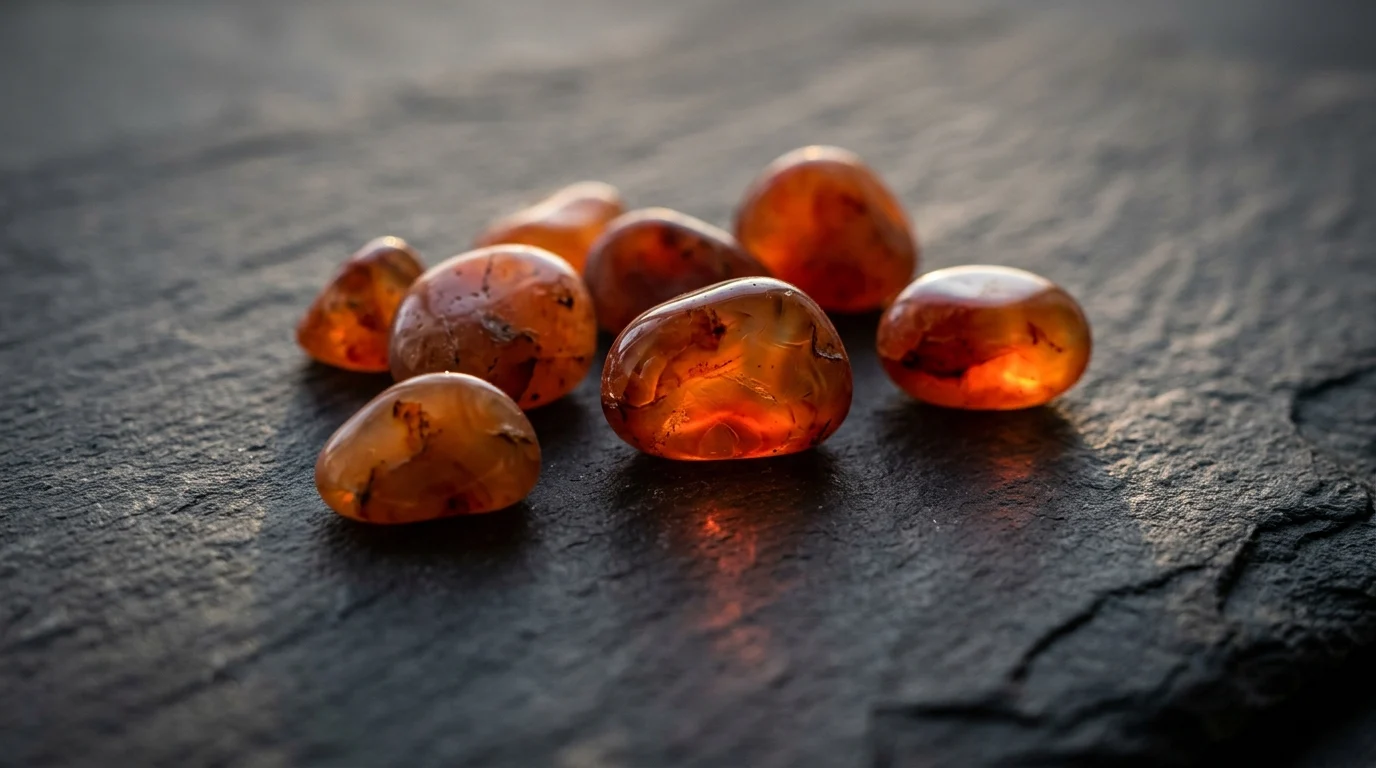
Quick Answer: Carnelian is a translucent, reddish-orange gemstone that is a variety of the mineral chalcedony, colored by iron oxide impurities. The name likely derives from the Latin word for “flesh,” referring to its warm color, and the stone has been used since antiquity for jewelry, seals, and amulets.
Carnelian carries a warmth that has drawn people to it for thousands of years. From Neolithic beads to Roman signet rings to modern healing crystal collections, this stone has appeared across cultures and centuries with remarkable consistency. Its color ranges from pale orange to deep reddish-brown, and that range has made it both versatile and recognizable.
Understanding carnelian means looking at three interlocking dimensions: its geological identity as a form of chalcedony, its long history of human use, and the symbolic meanings that cultures have attached to it. Each dimension adds depth to a stone that is often dismissed as merely decorative.
What Does Carnelian Mean?
At its core, carnelian is a brownish-red mineral commonly used as a semiprecious stone . It is a variety of the silica mineral chalcedony, and its color comes from impurities of iron oxide . The gemstone is closely related to sard, which is generally harder and darker, though the boundary between the two is not rigidly defined .
The name itself has an interesting etymology. Carnelian is derived from the Latin word caro or carnis, meaning “flesh,” in reference to the flesh color sometimes exhibited by the stone . An alternative spelling, cornelian, was influenced by the Latin word for “flesh-colored” . While cornelian may be marginally better on etymological grounds, carnelian is the more commonly used form today .
Pronunciation
British English: /kɑːˈniː.li.ən/ (kar-NEE-lee-uhn)
U.S. English: /kɑːrˈniː.li.ən/ (kar-NEE-lee-uhn)
Physical Properties at a Glance
Carnelian has a Mohs hardness of 6.5 to 7.0, a waxy to vitreous luster, and a white streak . It has no visible crystals and no cleavage, fracturing in a conchoidal, uneven, or splintery manner . Its chemical composition is silicon dioxide (SiO2), the same as quartz .
The Geological Identity of Carnelian
Carnelian belongs to the chalcedony family, which consists of microcrystalline quartz varieties. Unlike crystal quartzes such as amethyst, carnelian has a dull, waxy luster rather than a vitreous one . The stone forms through the intergrowth of quartz and moganite, two silica minerals with differing crystal structures .
Carnelian vs. Sard
The relationship between carnelian and sard is one of shade rather than substance. Carnelian tends to be lighter, ranging from orange to reddish-brown, while sard is darker, spanning deep reddish-brown to almost black . Carnelian is also generally softer and more brittle than sard . However, because the properties vary across a continuum, the boundary between the two names remains blurred, and many sources use them interchangeably .
Where Carnelian Is Found
Significant localities for carnelian include Ratnapura in Sri Lanka, Yanacodo in Peru, and deposits in Thailand . It has also been found in Indonesia, Brazil, India, Russia (Siberia), and Germany . In earlier eras, carnelian was gathered as water-worn pebbles in Egypt, India, and parts of Europe .
How Carnelian Is Treated
Most carnelian gemstones on the market are dyed or heat-treated to achieve additional color variations . The porous stone is often soaked in organic or vegetable dyes for several weeks to produce uniform surface color . Heating to approximately 2900 degrees Fahrenheit can alter iron oxide and other impurities to intensify or shift the color . Some carnelian may fade in light or heat, and in India, stones are sometimes exposed to the sun to turn brownish tints to purer reds .
A History Spanning Millennia
Carnelian’s history of human use stretches back to the Stone Age. The red variety of chalcedony has been used as beads since the Early Neolithic in Bulgaria, and the first faceted carnelian beads are described from the Varna Chalcolithic necropolis dating to the middle of the 5th millennium BC . The bow drill was used to drill holes into carnelian in Mehrgarh in the 4th to 5th millennium BC .
Carnelian in the Bronze Age and Antiquity
Carnelian was recovered from Bronze Age Minoan layers at Knossos on Crete, demonstrating its use in decorative arts around 1800 BC . It was mined or gathered as an ornamental stone since at least 3000 BCE . In ancient Egypt, carnelian was placed on mummies to assist the dead in their journey to the afterlife, while architects to the pharaohs wore it to denote rank and status .
Roman and Greek Use
During Roman times, carnelian was used widely to make engraved gems for signet or seal rings for imprinting a seal with wax on correspondence or other important documents . A practical property made it ideal for this purpose: hot wax does not stick to carnelian . The Greeks and Romans valued the stone highly for rings and signets, and some of their intaglios have retained their high polish better than many harder stones . The Romans also believed carnelian was a stone of courage, able to shore up confidence and strength .
Carnelian in Religious and Biblical Tradition
Carnelian appears in both the Hebrew Bible and the New Testament, where it carries symbolic weight connected to divine presence and value.
The High Priest’s Breastplate
In Exodus 28:17, carnelian is listed as one of the stones in the high priest’s breastplate: “And mount on it a row of stones: The first row shall be a ruby, a topaz, and a carnelian” . This inclusion signifies its importance and value among the stones representing the tribes of Israel .
Carnelian in Revelation
In the Book of Revelation, carnelian is associated with the appearance of God. Revelation 4:3 describes a vision of God’s throne: “And the One seated there looked like jasper and carnelian, and a rainbow that shone like an emerald encircled the throne” . The stone also appears in Revelation 21:20 as one of the precious stones in the foundations of the heavenly city . The use of carnelian in these visions highlights the fiery and majestic presence of God, symbolizing power and holiness .
| Biblical Reference | Context | Significance |
|---|---|---|
| Exodus 28:17 | High priest’s breastplate | Represents one of the tribes of Israel |
| Revelation 4:3 | Vision of God’s throne | Symbolizes divine majesty and brilliance |
| Revelation 21:20 | Foundations of the heavenly city | Denotes preciousness and permanence |
Carnelian Across Cultures and Languages
The stone has been known by many names in different traditions. The table below shows some of the forms the word takes across languages.
| Language | Form | Notes |
|---|---|---|
| English | Carnelian / Cornelian | Two spellings; carnelian is more common |
| French | Cornaline | Standard translation |
| Spanish | Cornalina | Standard translation |
| Portuguese | Cornalina | Standard translation |
| German | Karneol | Standard translation |
| Polish | Karneol | Standard translation |
Sources: Museum of Fine Arts Boston materials database .
Symbolism and Modern Associations
Carnelian’s symbolic life did not end with antiquity. The stone continues to carry meanings in contemporary culture, particularly in metaphysical and healing communities.
Historical Symbolic Meanings
In antiquity, carnelian was worn in cameos in the belief that it would ward off insanity and depression . In the Middle Ages, alchemists used carnelian when boiling stones to release the energy of other gemstones . The Romans associated it with courage and confidence .
Contemporary Metaphysical Associations
In modern times, some believe carnelian enhances self-esteem and creativity, combats feelings of inadequacy, and increases physical energy . It is sometimes used as a talisman to protect against fire and misfortune . Carnelian is considered part of the sacral chakra, which governs creativity, passion, emotional balance, and the flow of energy related to pleasure and relationships .
Birthstone Associations
Carnelian is the birthstone for the zodiac sign of Virgo . For most cultures from the 15th to the 20th century, carnelian was one of four birthstones for August . In 1912, the United States adopted peridot as the August birthstone, but in 2013, Britain recognized carnelian as a secondary birthstone after ruby .
How to Identify and Care for Carnelian
Visual Identification
Carnelian’s warm, translucent red-orange color and waxy luster are its most distinctive visual features. It can be confused with jasper, which is usually opaque, or with red jasper, which shares a similar color but lacks carnelian’s translucence . Sard is darker and harder, though the distinction is not always clear-cut .
Care Instructions
Clean carnelian stones with warm soapy water and a soft brush, then rinse well . Do not steam clean and do not boil the stone . Because some carnelian may fade in prolonged light or heat, storing it away from direct sunlight can help preserve its color .
Frequently Asked Questions
1. What is the simple definition of carnelian?
Carnelian is a translucent, reddish-orange gemstone that is a variety of the mineral chalcedony, colored by iron oxide impurities .
2. Where does the name carnelian come from?
The name derives from the Latin word caro or carnis, meaning “flesh,” referring to the stone’s flesh-like color . An alternative spelling, cornelian, was influenced by a similar Latin root .
3. Is carnelian the same as sard?
They are closely related varieties of chalcedony. Carnelian is typically lighter and ranges from orange to reddish-brown, while sard is darker and harder . The names are often used interchangeably because the boundary between them is not rigidly defined .
4. What is carnelian used for?
Historically, carnelian was used for beads, amulets, scarabs, signet rings, and engraved gems . Today, it is used primarily as a gemstone in jewelry and as a decorative stone .
5. Is carnelian mentioned in the Bible?
Yes. It appears in the description of the high priest’s breastplate in Exodus and in the visions of Revelation, where it is associated with the appearance of God’s throne and the foundations of the heavenly city .
6. What chakra is carnelian associated with?
Carnelian is associated with the sacral chakra, which is believed to govern creativity, passion, and emotional balance .
Conclusion
Carnelian is a stone that has never needed to reinvent itself. Its geological identity—a warm, iron-tinged form of chalcedony—has remained constant for millennia. What has changed is the meaning people bring to it: a Roman symbol of courage, a biblical stone of divine splendor, a Victorian cameo, a modern talisman for creativity. The stone absorbs these meanings without losing its essential character.
Whether you encounter carnelian in a museum case, a jewelry shop, or a collection of healing crystals, the same qualities persist. It is warm, translucent, and deeply colored a piece of the earth that humans have polished, carved, and treasured for at least seven thousand years.